Framed vs. Unframed Print-on-Demand Posters: What’s the Difference & Which to Offer
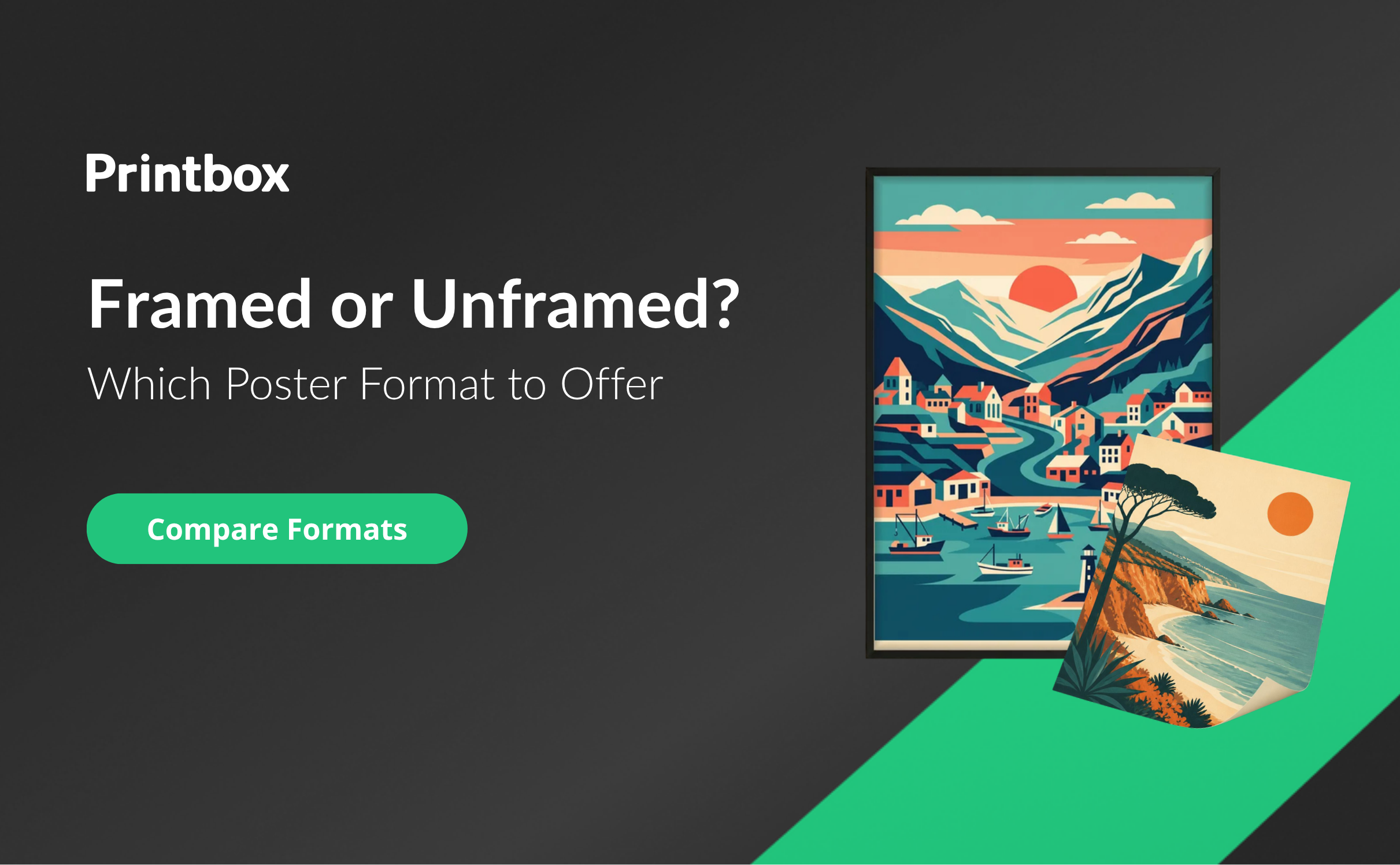
An unframed poster is the print alone, rolled or flat-packed, and the buyer chooses how to hang it. A framed poster arrives with the frame included, either assembled and ready for the wall or as an unassembled kit. The choice between framed vs unframed posters shapes your price point, shipping costs, damage rate, and who buys from you. Below: how the two compare, what “unassembled frame” means, and which one belongs in your catalog. For the wider picture, start with our guide on how to sell print-on-demand posters.
What Is an Unframed Print-on-Demand Poster?
An unframed poster is the printed sheet and nothing else. It ships in a tube or a rigid mailer, it weighs very little, and it leaves the frame decision to the customer. That last point cuts both ways. Some shoppers want to match an existing gallery wall or a frame they already own, and for them an unframed print is exactly right. Others want a finished piece, and an unframed listing sends them to a second store for the frame.
The economics are the main attraction. Your unit cost covers paper, ink, and packaging, so the retail price can sit low enough for impulse buys, seasonal designs, and multi-print orders. Shipping stays light, which matters most when you sell across borders. An unframed product is also the cheapest way to test a new design: if it does not sell, you have lost a listing, with no frames sitting in a warehouse.
What Is a Framed Poster, and What Does “Unassembled Frame” Mean?
A framed poster is the print delivered together with its frame. Sellers usually offer it in one of two forms.
Assembled. The print is mounted behind glass or acrylic and the frame is closed and ready to hang. This is the premium experience, and it is also the most fragile parcel you will ever send.
Unassembled. The frame arrives in parts (molding, backing board, glazing, hanging hardware) and the customer puts the print into it at home. Here is the unassembled frame poster explained in one line: the buyer gets everything needed for a framed poster and does the last five minutes of assembly.
This is where buyers get confused, and it is worth spelling out on your product page. The print on demand unassembled frame poster meaning is often misread in two directions. Some shoppers expect a hung-and-ready piece and feel short-changed by a flat box of parts. Others assume “unassembled” means the frame is missing altogether. A single sentence under the price (“frame ships flat, assembles in minutes, all hardware included”) heads off most of those support tickets and returns.
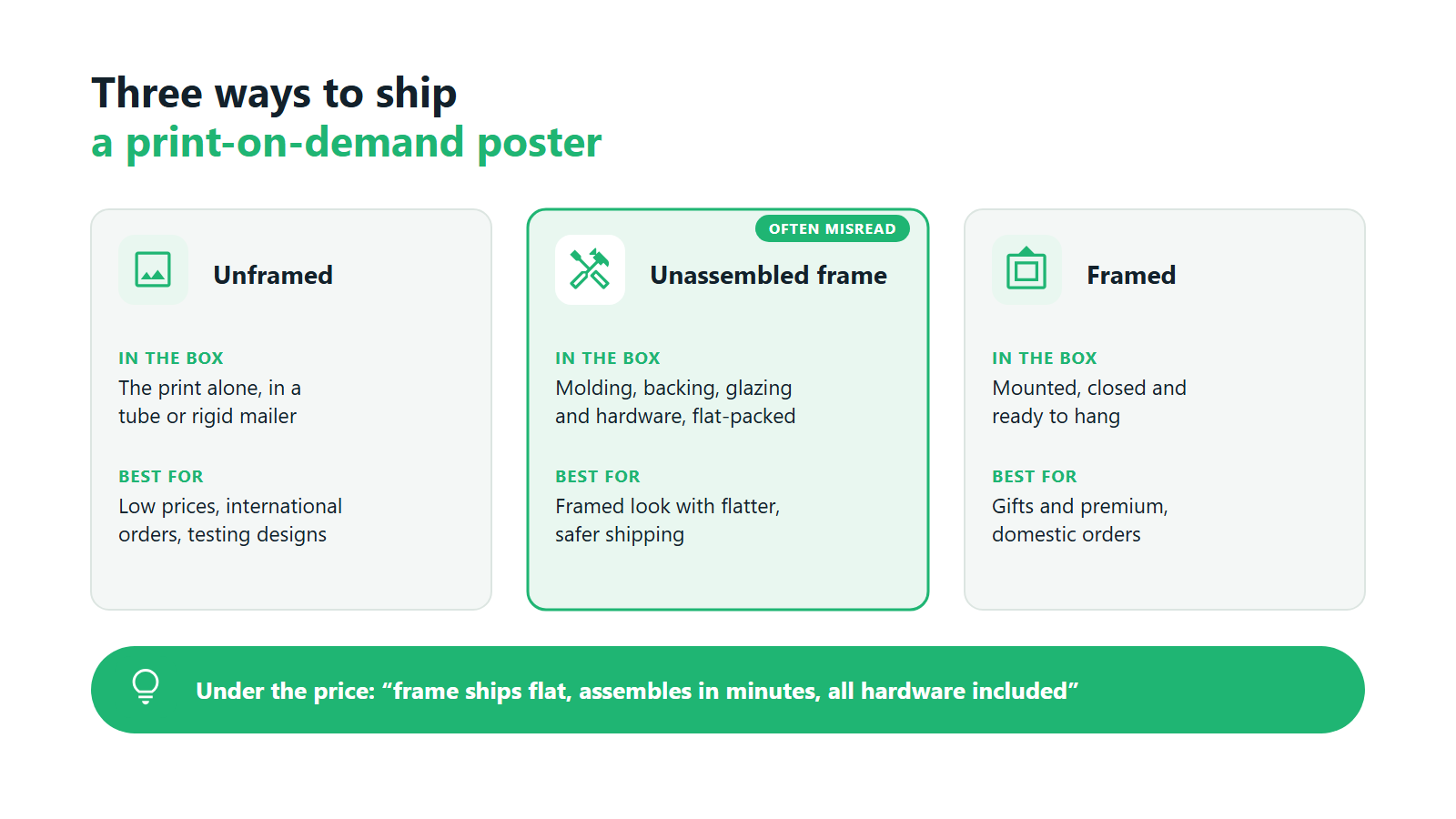
For the seller, the unassembled version sits between the other two. It ships flatter and survives transit better than an assembled frame, while still letting you list and price print on demand framed posters as a complete product.
Framed vs. Unframed: Comparison Table
| Feature | Unframed | Framed |
|---|---|---|
| Unit cost | Lowest: print, packaging, and a tube or mailer | Higher: frame, glazing, and protective packaging on top of the print |
| Shipping cost and complexity | Light, compact, and easy to ship internationally | Heavier and bulkier; assembled frames need corner protection and careful handling |
| Perceived value | A print the customer still has to finish | A finished, giftable piece that supports a premium price |
| Risk of damage in transit | Low: creased corners are the usual problem | Higher, especially with glass; unassembled kits reduce it |
| Recommended use | Entry prices, international orders, testing new designs, multi-print bundles | Gifts, higher-margin listings, domestic or regional shipping |
In Printbox, customers design posters in the Flex editor, picking the size and finish (matte or glossy, for example) with a realistic live preview as they go. For photo posters, the Prints editor also offers printed borders, drawn directly into the print file. A physical frame is a product option in your catalog. It travels with the order to whoever prints and frames it, your own production floor or a fulfillment partner, since Printbox is white-label software and never prints anything itself. In both cases, a print-ready production file is generated automatically for every order, so no one prepares files by hand when a customer adds a frame. The full poster setup is on our print-on-demand poster software page.
Which Option Should You Offer?
The answer to “should I offer framed posters?” depends on where your margin and your customers are. Settling framed vs unframed posters comes down to matching the format to the job each product has to do.
Lead with unframed when you are competing on an accessible price, shipping to many countries, or still finding out which designs sell. A low entry price lowers the barrier to a first order. Light parcels keep international delivery affordable. And because each test costs little, you can rotate designs quickly and promote only the winners. If you are weighing how much stock to hold at all, our comparison of bulk vs. print-on-demand poster printing covers that side of the decision.
Add framed when gifting is a big share of your demand, you ship mostly within one country or region, and your production partner can frame reliably. A framed poster print on demand listing earns more per order because the buyer pays for convenience and a finished look. It is also the simplest way to move part of a poster range from commodity to premium. Gifts are where that premium lands most easily: someone buying a present rarely wants to shop for a frame separately.
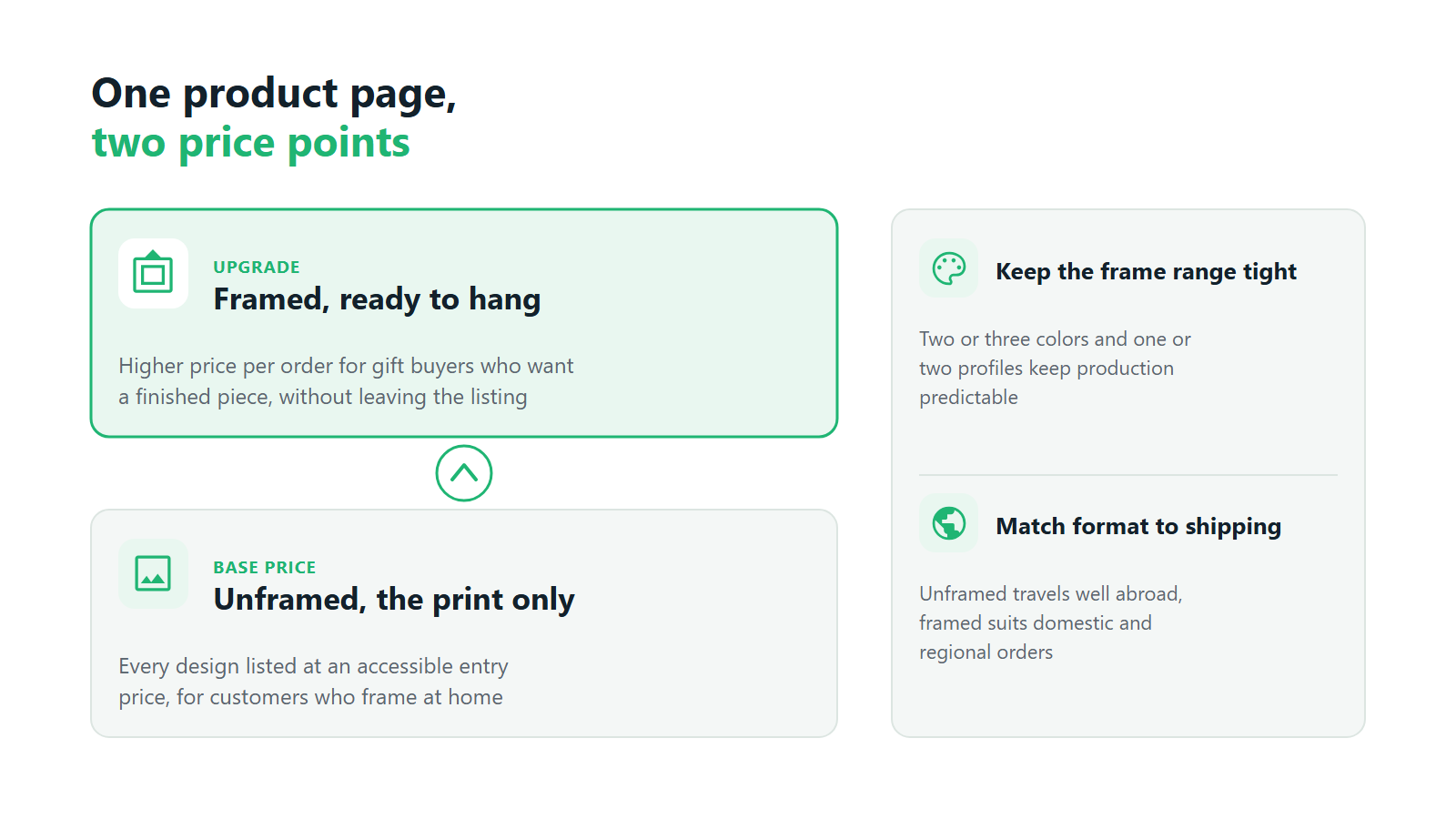
Offer both when you can. The strongest setup for most stores lists every design unframed at the base price, with framed as an upgrade on the same product page. Customers who only want the print pay the lower price, and gift buyers upgrade without leaving the listing. Print on demand framed posters then work as a margin lever on top of a catalog you are already selling. Keep the frame range tight (two or three colors, one or two profiles) so production stays predictable and the product page stays simple. If you also sell canvas, our look at canvas vs. poster sales shows how the formats compare on profit and demand.
Frequently Asked Questions
What does “unassembled frame” mean when buying a print-on-demand poster?
It means the frame ships in parts with the poster, and the buyer assembles it at home. The package normally holds the molding, a backing board, glazing, and hanging hardware. The print on demand unassembled frame poster meaning is worth stating on every listing, because shoppers often confuse it with "no frame included." Sellers like the format because it ships flatter and arrives intact more often than an assembled frame.
Is it more profitable to sell framed or unframed posters?
Framed posters usually earn more per order, while unframed posters usually sell in higher volumes at a lower price. Which is more profitable depends on your frame cost, your shipping costs, and how many of your buyers are shopping for gifts. Many stores get the best result from a mix: unframed as the entry product, and print on demand framed posters as the upgrade that lifts the average basket.
Does offering framed posters increase shipping costs significantly?
Yes, in most cases. A frame adds weight and bulk, glass needs protective packaging, and carriers price large, heavy parcels accordingly. Unassembled frames soften the jump because they pack flat, which is the practical case for explaining the print on demand unassembled frame poster meaning on every framed listing. If most of your orders cross borders, keep print on demand framed posters for the markets closest to your production partner.
Can I offer both framed and unframed options from the same catalog?
Yes. Framing works as an option on the same poster product, so one design can be sold unframed or framed without creating a separate listing for each. With Printbox, EC Sync keeps your store catalog (products, variants, sizes, and finishes) in sync with Printbox automatically. One source feeds the poster frame options print on demand shoppers see on Shopify, Shopware, or a custom store. Orders then flow to production automatically. If Shopify is your main channel, our guide to selling print-on-demand posters on Shopify walks through the setup.
What are the key features of a print-on-demand poster tool from Printbox?
The Flex editor handles poster design, sizes, and finishes with a realistic live preview, and the Prints editor adds printed borders for photo posters. The same platform takes a single custom print or a large order of dozens or hundreds of prints in one session, with configurable quantity-based price tiers. Every order gets a print-ready production file automatically. The software is white-label, so the storefront carries your brand and the printing stays with your own presses or a fulfillment partner. Printbox has launched stores in more than 50 countries. For original artwork, Masterpiece AI, an optional AI path in the Flex editor, creates designs from a text prompt or restyles an uploaded photo, upscales the result to print resolution, and moderates every prompt automatically. That makes it easier to build a framed poster print on demand range around new designs. You can see how the pieces fit together on our print-on-demand poster software page, and weigh the alternatives in our guide to choosing print-on-demand poster software.

Sylwia Kopeć
She collaborates with her team to develop and implement the company's marketing strategies. With a strong background in marketing communications, online marketing, and content marketing, she efficiently integrates these strategies into the brand. Her focus on omnichannel digital campaigns, keen analysis of client needs, and creative approach have delivered significantly enhanced Printbox's market presence.