Before you decide to build — answer these five questions.
If your company sells — or is planning to sell — personalized print products, at some point someone will ask: should we build this software ourselves?
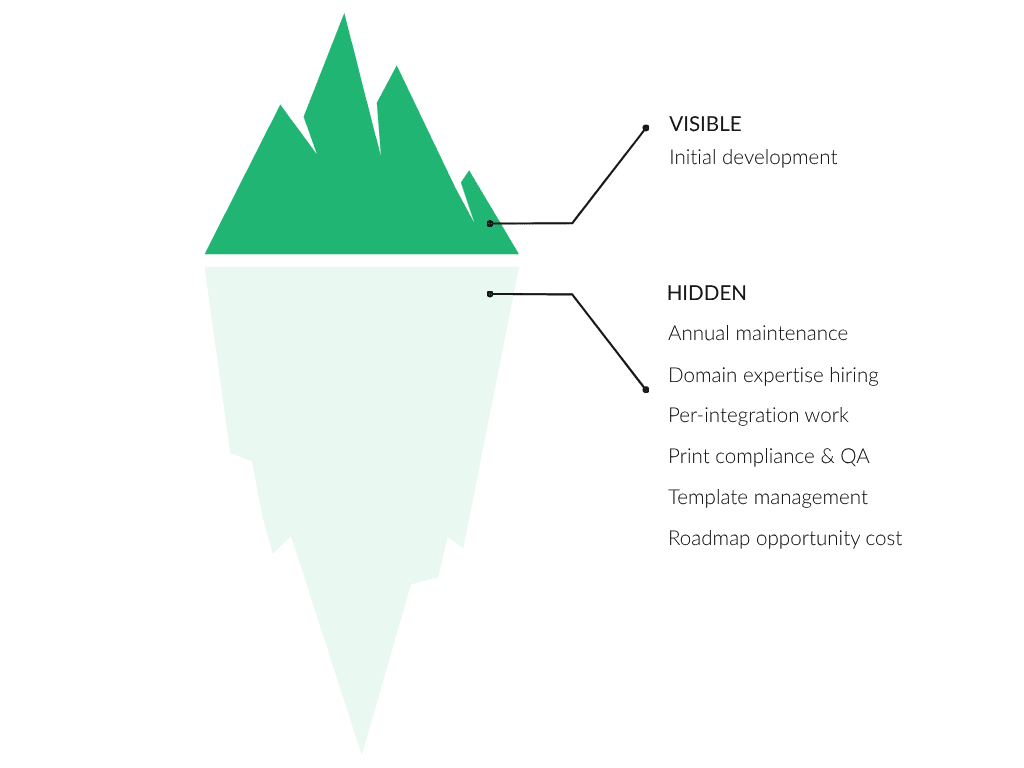
of what you paid to build a custom platform is spent again every single year — just to maintain it.
These aren't trick questions.
Most build-vs-buy decisions look straightforward on a spreadsheet. The gap between what's estimated and what's real usually shows up 12–18 months after launch — in maintenance bills, in team turnover, in the engineer who holds all the context and just gave notice.
These five questions won't make the decision for you. But if you can't answer three or more with confidence, the decision is more open than it looks right now.
The five questions.
Answer honestly. "I'm not sure" counts as an answer.
- 01
Does your build estimate include the year after launch?
Most estimates don't include a single line about post-launch costs. The maintenance bill — typically 15–25% of your original build cost — arrives every year, starting about six months after go-live.
The initial development is rarely the expensive part.
- 02
Does your team include someone who has shipped a print-quality rendering engine?
Not a preview layer, nor a PDF export. A rendering engine that a production supplier will accept — across product types, color profiles, and file formats — without rework.
A customer uploads a HEIC file from an iPhone, converted on a Windows machine, with an embedded color profile that maps incorrectly to CMYK at the supplier. The screen preview looks fine. The print doesn't. The reprint cost is real.
- 03
If the person who owns this project leaves in 18 months, what happens?
Custom-built platforms concentrate knowledge in the people who built them. That knowledge doesn't live in the code — it lives in the decisions nobody documented.
Internal lock-in — to your own architecture, your own technical debt, the engineer who holds critical context — is harder to exit than vendor lock-in.
- 04
When your first serious traffic spike hits, will you know which part of your infrastructure fails first?
The first serious spike is always a surprise — not because teams don't plan for scale, but because you can't know which part fails first until it does.
That knowledge only comes from having been through it. Multiple times, across different clients, different geographies, different peak seasons.
- 05
If you change course in two years, what does migrating away from what you built actually cost?
Vendor lock-in gets all the attention. Internal lock-in — to your own architecture, your own technical debt, the engineer who holds critical context — is harder to exit.
And it rarely appears in the original estimate.
If you answered three or more with “I'm not sure” — that's not a bad sign.
It means the decision is more open than it looks right now. Most teams who've been through a failed build didn't start with bad intentions — they started with incomplete questions. This is a good time to have an honest conversation before the estimate becomes a commitment.
More orders in their first peak season after switching from an in-house platform. A European photo products company saw immediate results where their custom build had hit a ceiling.
Web revenue after moving from a competing provider. A global photo products company operating across three continents doubled their web revenue after making the switch.
Both decisions started with questions very similar to these. We're often the next conversation after a team has tried building their own solution — or after they've outgrown another vendor.
Get an honest read on your specific situation.
We're happy to think it through with you — including when building is the right call. We'll tell you what we've seen from the inside. No pitch. No follow-up unless you want one — just an honest conversation about what makes sense for where you are right now.
Konrad Chmielewski
Chief Sales Officer
Stay connected through our social media profiles: