Bulk vs. Print-on-Demand Poster Printing: Which Model Fits Your Business
Should I print posters in bulk or on demand? Bulk printing means ordering a large run of one design up front, paying less per poster and storing the stock until it sells. Print-on-demand means each poster is printed only after a customer orders it, with no stock and no minimum, at a higher cost per unit. The right model depends on three things: how certain you are about demand, how much personalization your customers expect, and how much unsold inventory you can afford to carry. Many poster businesses end up running both.
What Is Bulk Poster Printing?
Bulk printing is the traditional way to produce posters: you choose a design, order hundreds or thousands of copies, pay for the run, and sell from stock. The economics come from setup costs. Offset printing needs plates and press calibration for every design, and that cost is the same whether the printer runs fifty sheets or five thousand. Every poster printing minimum order quantity exists for that reason, since the printer needs enough copies to spread the setup over.
Once you pass the minimum, the price per poster drops with every additional copy. That is the main attraction, and for the right design it is a strong one.
The costs sit elsewhere. You pay before you sell anything, so cash is tied up in paper. The stock needs dry, flat storage or tubes, because posters crease, curl, and fade. And every design you print is a bet: if it does not sell, the leftovers are a write-off. A wholesale poster printing business runs on exactly this model, printing large runs and selling them to shops, galleries, and event organizers. It survives by being very good at predicting which designs will move.
What Is Print-on-Demand for Posters?
With print-on-demand, nothing is printed until a customer orders. Each order becomes a single print job for one poster, or for the exact set the customer chose, and it is produced and shipped from there. There is no minimum order, no stock, and no warehouse.
Digital presses made this model practical, because they need no plates and can print one copy as easily as a hundred. The trade-off is unit cost. With no setup to spread across a run, and each order handled individually, a poster printed on demand costs more to make than the same poster in a bulk run. In return, you never pay for a poster nobody wants.
The bigger advantage is that every order can be different. A customer can upload a photo, add a name or a date, pick a size, and receive a poster that exists only for them. That matters for any store built on personalization. On-demand production meets that expectation by default, because each poster is printed for one customer. Our complete guide to selling print-on-demand posters covers the full setup, from product range to storefront.
The same logic applies further up the supply chain. Suppliers offering wholesale poster print on demand print single orders for retailers under the retailer’s brand, so the shop carries a wide catalog without buying any of it first.
Bulk Printing vs. Print-on-Demand: Comparison Table
This poster printing cost comparison covers the six factors that usually settle the decision.
| Aspect | Bulk Printing | Print-on-Demand |
|---|---|---|
| Upfront cost | High: the full run is paid before any sale | Low: you pay per order, after the sale |
| Storage | Required: flat storage or tubes, protected from light and humidity | None: posters ship as they are printed |
| Unit cost at scale | Lowest, and it keeps falling as the run grows | Higher and roughly flat, whatever the volume |
| Design flexibility | One design per run, fixed once printed | Every order can differ in design, size, and personalization |
| Time to test new designs | Slow: each test means a new run and a new minimum | Fast: a new design can go live the day it is ready |
| Risk of unsold stock | High: leftovers are a sunk cost | None: nothing is printed without an order |
Read the table as a trade. The choice in bulk vs print on demand posters comes down to paying for certainty in advance, or paying a little more per poster so you never need that certainty.
When Bulk Printing Makes Sense
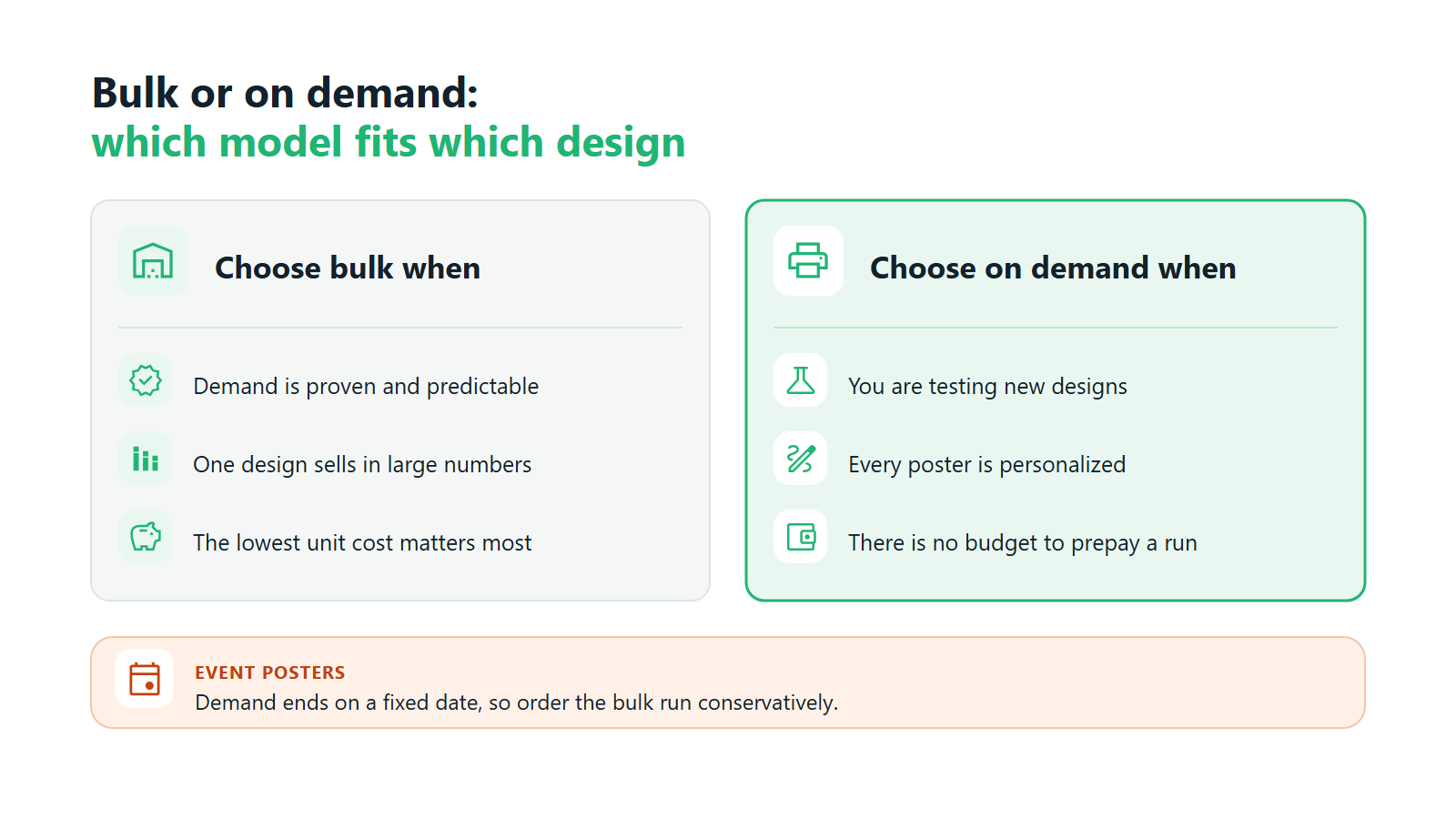
Bulk wins when demand is proven and predictable. Think of a design that has sold steadily for months, or a poster for a large festival, a concert tour, or a sports final. In each case you know roughly how many people will want one and when. That knowledge is what turns a bulk run from a gamble into a purchase.
Volume is the second condition. Bulk pays off when a single design sells in large numbers, because that is the only way to reach the quantities where the unit price falls meaningfully. Ten designs selling twenty copies each will rarely justify ten separate runs.
The third condition is margin pressure. If you sell through retailers who expect trade prices, or compete on price in a crowded category, the lowest possible unit cost may matter more than flexibility. In any bulk poster print on demand comparison, this is the scenario where bulk comes out clearly ahead.
One caution about event posters: demand ends on a fixed date. Order conservatively, because leftovers from last year’s festival have almost no resale value.
When Print-on-Demand Makes Sense
Print-on-demand fits almost every situation where you cannot predict demand with confidence. The most common is testing. A seller with forty new designs has no way of knowing which five will sell, and printing a run of each would mean funding thirty-five failures. On demand, all forty go live, the market picks the winners, and the losers cost only the time it took to make them.
Personalization is the second case, and here there is no real alternative. A poster with a customer’s own photo, a pet portrait, or a family name cannot be printed before the customer creates it. Newer creation methods push the same way: when shoppers can generate their own artwork, the catalog is effectively unlimited, as we explain in how AI-generated poster art works for print-on-demand sellers.
The third case is capital. A new brand, a photographer opening a shop, or a retailer adding posters to an existing range often has no budget to prepay a large run. For them the bulk poster print on demand question is already answered, because on demand is the only model that lets them start without inventory.
How Printbox Software Supports Both Poster Sales Models
Printbox is white-label software for selling posters under your own brand, while printing stays with your own presses or a fulfillment partner. Customers design posters in Printbox’s Flex editor with a realistic live preview, choosing sizes and finishes such as matte or glossy. The Prints editor covers photo posters ordered in volume. For every order, Printbox generates a print-ready production file automatically, so nobody prepares files by hand, order by order. The same platform handles one custom poster and a large order of dozens or hundreds of prints in a single session. Quantity-based price tiers can be configured for large orders. EC Sync keeps your store catalog of products, sizes, and finishes in sync with Printbox automatically, whether you sell on Shopify, Shopware, or a custom store connected via API. Orders then flow to production automatically as well. The details of the poster setup are on our print-on-demand poster software page.
Can You Combine Both Models?
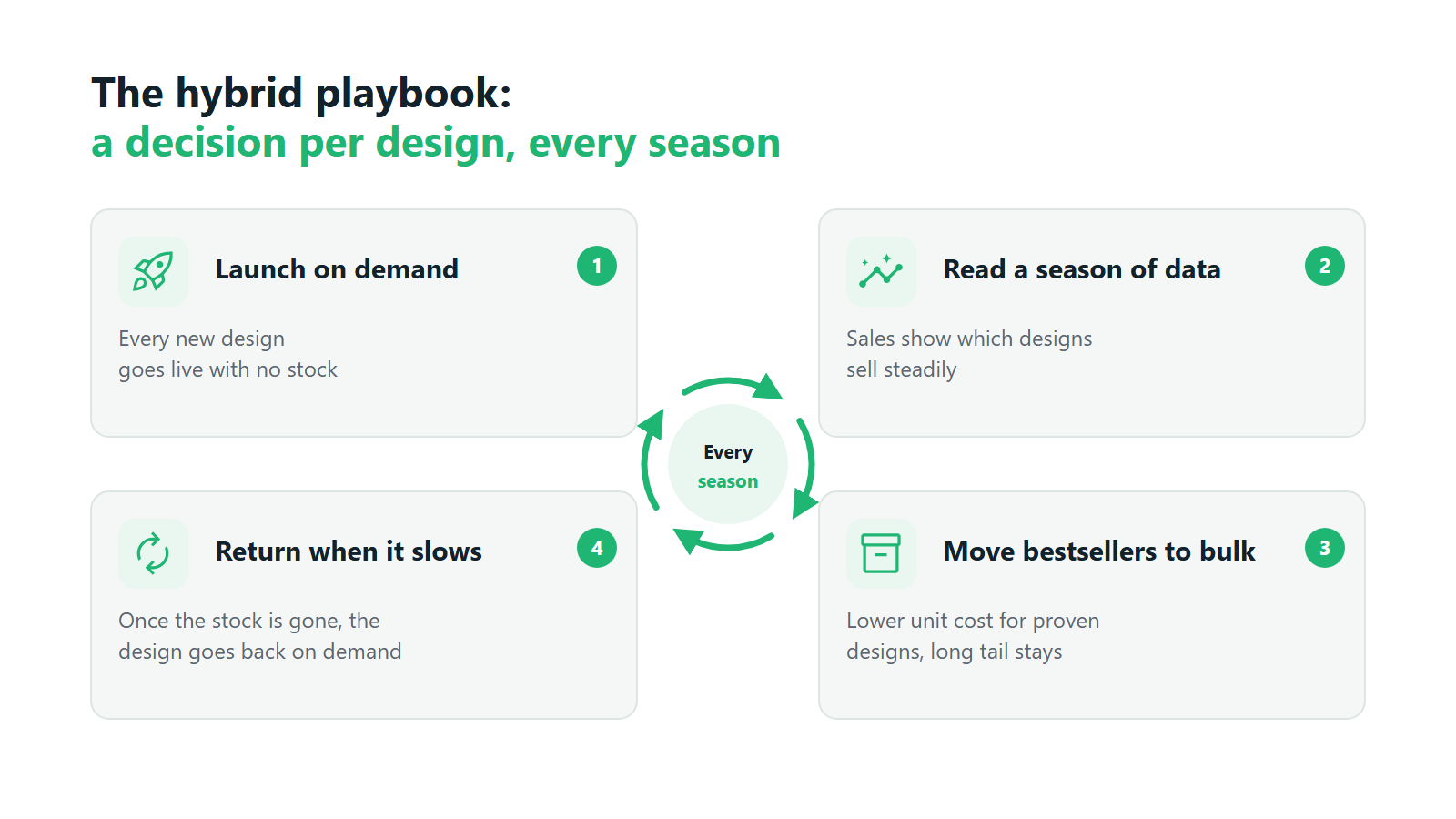
Yes, and many established sellers run both. The principle is simple: print the proven best-sellers in bulk for the lower unit cost, and keep everything new or personalized on demand to test demand without risk.
In practice, that means launching every new design on demand first. After a season, the sales data shows which designs sell steadily enough to justify a run. Those move to bulk, while the long tail stays on demand. If a bulk design slows down, stop reordering it and move it back to on demand once the current stock sells through. Seen this way, bulk vs print on demand posters becomes a decision you make per design, based on data, and revisit every season. Sellers whose best-sellers outgrow a fulfillment partner often take the next step and bring printing in-house, which we cover in when to move from print-on-demand to in-house production.
The same test-first habit helps with format decisions too. Our comparison of canvas vs. poster sales shows how the choice of format changes what a design can earn. For a bulk poster print on demand hybrid, the practical requirement is a storefront that can sell both from one catalog. That way the customer never sees which posters come from stock and which are printed to order. Retailers sourcing through wholesale poster print on demand can apply the same split, stocking only the few designs their data has proven.
Frequently Asked Questions
Is print-on-demand more expensive than bulk printing per poster?
Per poster, yes. A bulk run spreads setup costs across many copies, so its unit price is lower once you pass the minimum. The total cost tells a different story, because bulk adds storage, the capital tied up in stock, and the write-off on anything that does not sell. When you run the full bulk poster print on demand math, designs with uncertain demand usually come out cheaper on demand.
What’s a typical minimum order quantity for bulk poster printing?
There is no industry-wide standard poster printing minimum order quantity. It depends on the printer and the press. Offset printing carries fixed setup costs per design, so minimums are set high enough to cover them, and the best unit prices only arrive at large quantities. Digital printers work with much lower minimums, though the unit price falls more slowly. Ask several printers for their price breaks at different quantities before you commit.
Can I switch from bulk printing to print-on-demand later?
Yes. Most sellers sell through their remaining stock, then move those designs to on demand as the stock runs out. The switch is easiest when your storefront and production are handled separately, so changing how a poster is produced does not mean rebuilding the shop. The same applies to suppliers who move from bulk distribution to wholesale poster print on demand. If you are comparing platforms for the on-demand side, our guide to choosing print-on-demand poster software sets out what to look for.
Does print-on-demand work for personalized or one-off poster designs?
Yes, it is the only model that does. A personalized poster cannot exist before the customer designs it, so it has to be printed after the order. On demand, a one-off design costs the same to produce as any other single print. With Masterpiece AI, customers can also create artwork from a text prompt or restyle their own photo. The result is upscaled automatically to print resolution, so it is ready for production without manual rework.
What are the key features of a print-on-demand poster tool from Printbox?
Printbox's Flex editor lets customers design posters and choose sizes and finishes with a realistic live preview, and the Prints editor covers photo posters ordered in volume. Every order gets a print-ready production file automatically. One platform handles a single custom poster and an order of hundreds of prints in one session, with configurable quantity-based price tiers. EC Sync keeps the catalog in sync with Shopify, Shopware, or a custom store, and orders flow to your own presses or a fulfillment partner automatically. Masterpiece AI adds optional AI creation, with every prompt moderated automatically to block inappropriate content and prompts that reference copyrighted characters or public figures. Printbox has launched stores in more than 50 countries.

Sylwia Kopeć
She collaborates with her team to develop and implement the company's marketing strategies. With a strong background in marketing communications, online marketing, and content marketing, she efficiently integrates these strategies into the brand. Her focus on omnichannel digital campaigns, keen analysis of client needs, and creative approach have delivered significantly enhanced Printbox's market presence.