Level Up Your Personalized Product Business: From Commodity to Premium

Scaling a business means selling more. Leveling up means raising what each product is worth to the customer: better materials, deeper personalization, and an experience people remember and pay more for. The two can happen together, but they call for different decisions. This guide explains how to level up your personalized product business in four steps. It covers what separates commodity from premium personalization, how to raise product quality and the customer experience, and which signs show you are ready.
Commodity Personalization vs. Premium Personalization
A name printed on a mug is personalization. So is a lay-flat photo book that tells the story of a wedding, designed with care and printed on heavy paper. Both are personalized, but only one of them can sell at a premium price. The commodity vs premium personalization gap comes down to four things.
Material quality. Paper weight, cover materials, frame finishes, print technology. Premium products feel different the moment a customer holds them.
Design depth. A commodity product gives the customer a text field. A premium one gives them room to create: layouts, frames, masks, and multiple photos arranged into something that looks professionally designed.
Emotional resonance. Premium products are tied to moments that matter, such as a family history, a first year, or a milestone anniversary. The emotional value of the content supports a higher price.
Attention to detail. Color accuracy, clean cropping, packaging, and the unboxing moment all signal quality. Small flaws signal the opposite, and customers notice them most on the products they care about most.
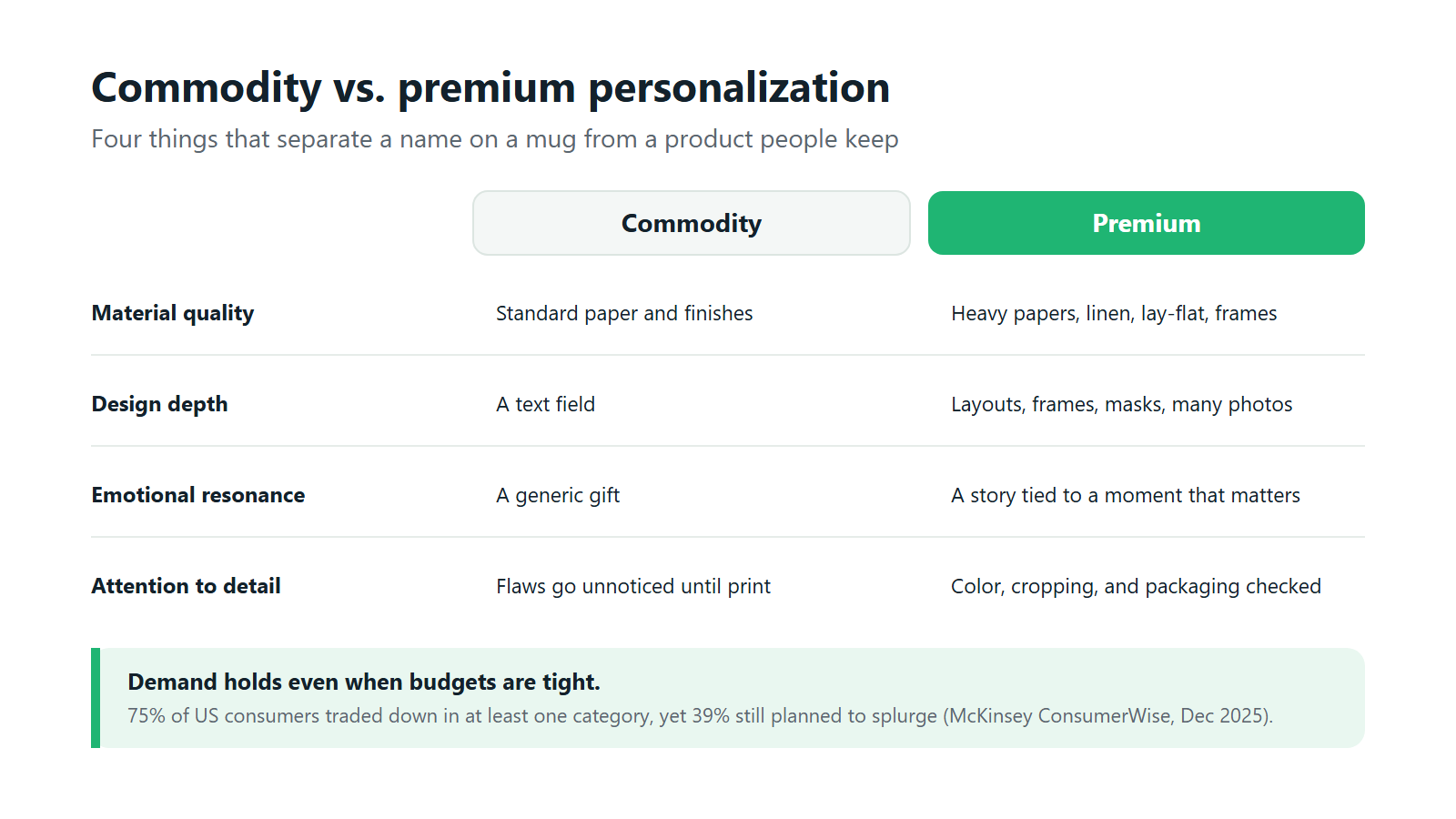
There is demand for this end of the market even when budgets are tight. McKinsey’s ConsumerWise research from December 2025 found that while 75% of US consumers reported switching to cheaper options in at least one category, 39% still planned to treat themselves. Premium personalized products are well placed to capture that spending, because they combine a meaningful occasion with a product people keep. Our guide to selling premium products and showcasing their quality covers how to present them.
Elevating Product Quality
The most visible way to move into premium is to upgrade the catalog itself: lay-flat binding, premium papers, linen or leather covers, gallery-grade canvas, and wooden or metal frames. Start with the products that already sell best and add a premium tier alongside them. Customers who already buy the standard version are a natural first audience for the upgrade.
The harder problem is the customer’s own photos. Many of these images come straight from a phone, and a dark or flat photo printed large shows every flaw. Fixing that by hand for every order stops being practical as soon as volume grows.
Printbox helps stores raise product quality without adding a design team. Through its partnership with Perfectly Clear, photos can be enhanced automatically before printing: the AI corrects exposure, color, sharpness, and noise so images look natural and vibrant. Stores can run the enhancement in the background for every photo or offer it to customers as an optional add-on before they order. For premium products such as photo books and albums, the Advanced Editor gives customers a full-screen design space with frames, masks, and clip art, so the finished product looks professionally designed. More on building a premium photo book range is on our photo book software page. Together, they improve personalized product quality on every order, including the ones no designer has time to check.
Elevating the Customer Experience
Premium pricing only works if the experience of creating the product feels premium too.
Real-time preview. Customers should see exactly what they will receive while they design. An accurate preview helps reduce mistakes, reprints, and returns, and it builds the confidence needed for a higher-priced order.
Mobile-first design. Many of the photos people want to print live on their phones. A design experience that works well on a small screen is a baseline expectation for a premium brand.
A shorter path from idea to order. A premium experience should still be quick. The more effort a customer has to put in, the more likely they are to leave before finishing.
AI can make the process faster and the result better at the same time. Smart Creation, an optional extension of Printbox’s Advanced Editor, builds a photo book automatically from a customer’s photos, sorting images by date, location, and quality and arranging them into a clear story. According to Printbox data from 2024, users spend up to 70% less time on their projects on mobile web and 60% less on desktop. The customer gets a professional-looking layout in a fraction of the time. For anyone asking how to elevate your personalized product business without slowing customers down, this is the tool to use. Read more in our look at how Smart Creation transforms photo book design.
Signs You’re Ready to Level Up
A few signals suggest it is time to move into premium.
Returning customers ask for more. When repeat buyers want more pages, better covers, more layout freedom, or special editions, they are telling you there is room above your current range.
You compete mainly on price. If your main product is identical to what competitors sell and the only option left is a discount, price has stopped working as a strategy. Standing out in personalized products market niches takes an offer competitors cannot match on price.
Margins keep shrinking. A race to the lowest price squeezes margins every season. Our analysis of what is happening to photo product margins in 2026 shows why that pressure is here to stay.

If two or more of these apply, it is a good moment to level up your personalized product business. A focused premium niche is often the most reliable route, as our playbook on profitable niches in personalization explains. Growth in volume is a separate question, covered in our guide Is Print-on-Demand Scalable?
Frequently Asked Questions
What does “leveling up” a personalized product business actually mean?
It means raising the value of each order through better materials, deeper personalization, and a more polished customer experience. Scaling adds volume. When you level up your personalized product business, each product becomes something customers are willing to pay more for, and the two strategies can support each other.
Do I need new equipment to offer premium personalized products?
Not always. Many premium upgrades, such as better papers, covers, or packaging, can be sourced through existing production partners or added to current equipment. Others, like lay-flat binding or specialty finishes, may need new machines or a partner that offers them. Start with the upgrades your current setup supports and test demand before investing.
Can AI tools improve product quality without hiring a design team?
Yes. Automatic photo enhancement corrects exposure, color, and sharpness in customer photos before printing, and AI layout tools such as Smart Creation arrange photos into professional-looking designs. With Printbox, both work inside the ordering process, so quality improves without adding designers or manual editing.
Is premium personalization more profitable than high-volume commodity products?
It can be, because higher prices and a stronger brand protect margin, while commodity products tend to compete on price alone. The commodity vs premium personalization choice also affects risk: premium lines depend on quality and brand, commodity lines on volume and cost. Many businesses keep both, using commodity products to bring in customers and premium personalized products to build margin.
What are the key features of Printbox’s software for premium photo products?
Printbox supports a premium photo product business with the Advanced Editor for photo books, albums, and calendars, offering full-screen design with frames, masks, and clip art. Smart Creation, an optional extension of the Advanced Editor, builds photo books automatically, sorting photos by date, location, and quality. Automatic photo enhancement through the Perfectly Clear partnership improves customer photos before printing. Together, they answer the practical question of how to elevate your personalized product business: better photos, richer design, and less effort for the customer.

Sylwia Kopeć
She collaborates with her team to develop and implement the company's marketing strategies. With a strong background in marketing communications, online marketing, and content marketing, she efficiently integrates these strategies into the brand. Her focus on omnichannel digital campaigns, keen analysis of client needs, and creative approach have delivered significantly enhanced Printbox's market presence.


