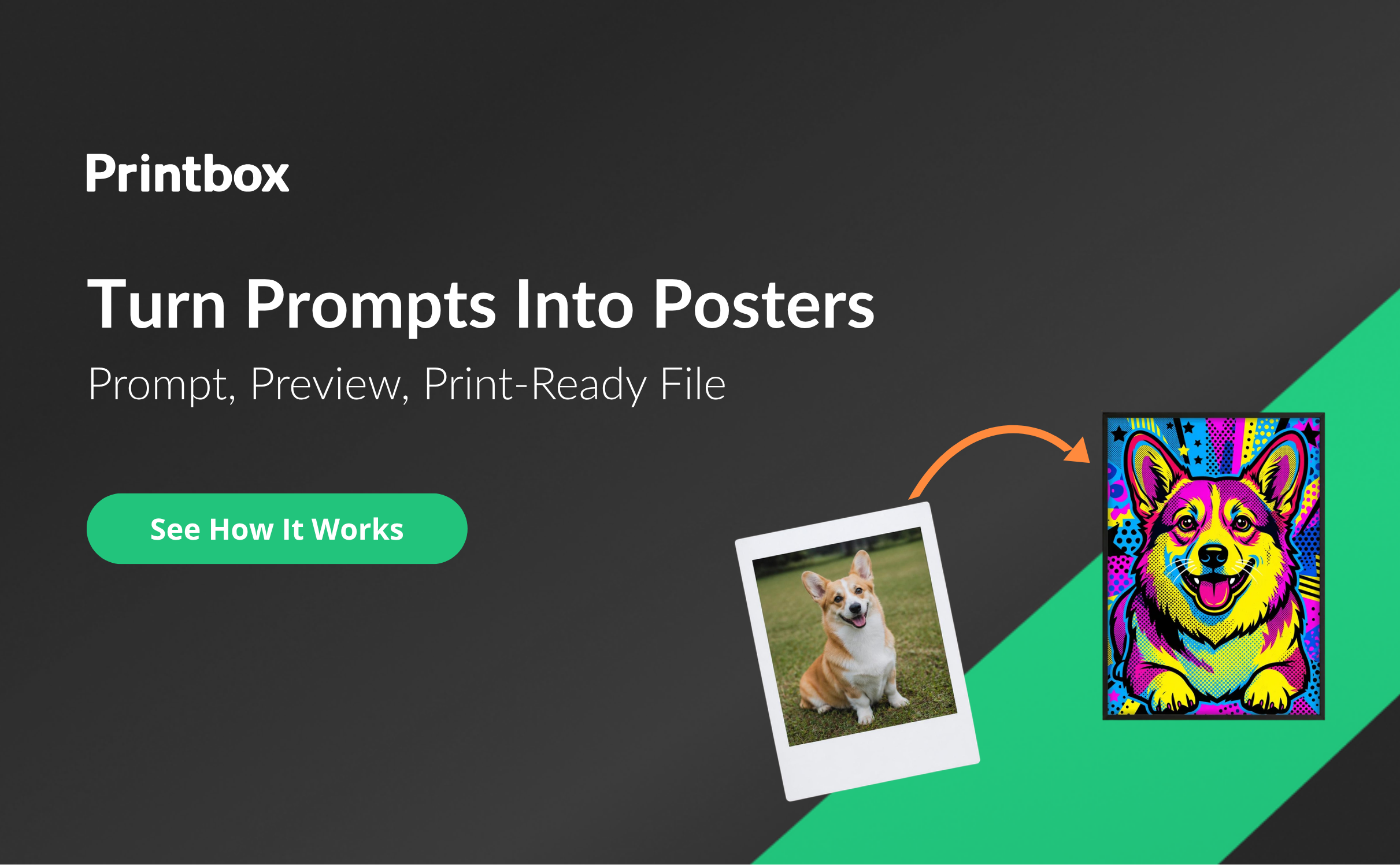
AI-generated poster art works in four steps. A shopper describes an idea or uploads a photo, the AI generates the artwork, the shopper checks it in a live preview, and the platform turns the approved design into a print-ready file for production. For the seller, every prompt a customer types becomes a new design the catalog did not have yesterday. This guide is written for online stores and print shops weighing an AI poster generator for print on demand sellers as part of their offer. Shoppers making a single poster for their own wall will find it more detailed than they need.
Why Offer AI-Generated Posters in Your Store
Posters are one of the easiest personalized products to sell and one of the hardest to design for. The format is simple, the price point is accessible, and almost anyone has a wall that needs something on it. The problem sits on the shopper’s side: a blank canvas asks for a skill most people do not have. Our complete guide on how to sell print-on-demand posters covers the whole category. This article focuses on the AI layer.
A lower barrier for customers without design skills. McKinsey’s research on next-generation personalization, cited in StackAdapt’s 2026 retail report, found that 71% of consumers expect personalized interactions. Expectation and ability are two different things, though. A shopper who wants a poster of “a fox reading in a snowy forest, in a mid-century print style” can describe it in seconds and could never draw it. AI closes that gap, and stores that decide to sell AI generated posters can capture the demand those shoppers already have.
A growing catalog without a design team. A traditional poster shop grows one design at a time, and each design costs designer hours before it earns anything. Print on demand AI art posters change that arithmetic: the customer’s prompt produces the design, and nothing is printed until someone pays for it. The same logic applies to seasonal peaks, when the design queue is usually the first thing to back up. For an AI generated poster art business, catalog growth stops depending on how many designers you employ.
A reason to choose your store over a template shop. Publicis Sapient’s Guide to Next Retail 2025 describes generative AI as turning shoppers into co-creators, and 63% of the retail executives it surveyed rate hyper-personalization as very or extremely important over the next three years. A template library gives every visitor the same hundred designs. Generative AI posters for ecommerce give each visitor a design that did not exist before they arrived, which is a much harder offer for a competitor to copy.
How AI Poster Generation Works, Technically
Under the hood, the flow has four stages, and each one has a job the seller should understand before switching it on.
- Input. The customer either types a text prompt or uploads a photo. Text prompts suit shoppers who start with an idea; photo uploads suit the much larger group who start with a picture they love, whether a pet, a city skyline, or a holiday snapshot. For a store, the ability to turn photo into poster with AI matters because customers already hand over photos all the time.
- Generation. The AI model creates artwork from the prompt, or restyles the uploaded photo into a new visual style such as watercolor, line art, or vintage travel print.
- Live preview. The shopper sees the result at poster proportions before buying and can generate again until the design feels right.
- Production file. Once the order is placed, the design is prepared as a print-ready file and sent to production. This is the stage most generic AI image tools leave out, and it decides whether an AI poster can actually be sold.
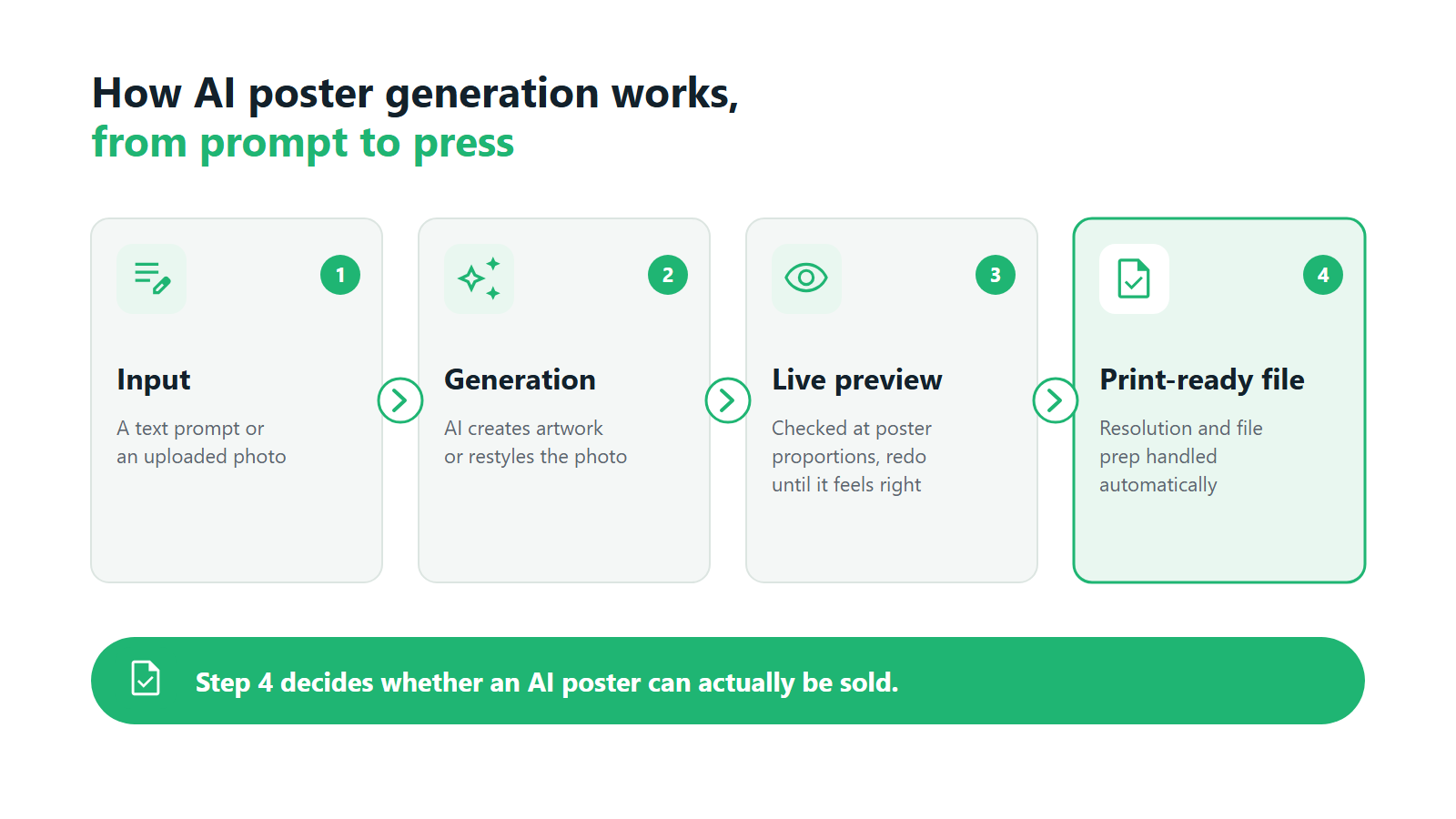
That last step deserves attention. An image that looks sharp on a phone screen can fall apart at 24 x 36 inches. Any system worth using has to handle resolution, proportions, and file preparation automatically, or someone on your team ends up fixing files by hand for every order.
In Printbox, AI poster generation runs on Masterpiece AI. It works in two modes: text-to-image generates original poster artwork from a written prompt, and image-to-image restyles a photo the customer uploads into a new, stylized design. Shoppers who do not know where to start can open an inspiration gallery and remix an existing design. The output is upscaled automatically to print resolution and passes through Printbox’s standard print engine like any other photo, so no one prepares AI files separately. Printbox is white-label software: the posters are printed on your own presses or by your fulfillment partner, under your brand.
Content Moderation and Production Control
Giving customers a prompt box means giving them a way to ask for anything. A seller who adds print on demand AI art posters to the catalog needs to know what happens when someone types a prompt that should never reach a press.
In Masterpiece AI, every prompt is moderated automatically before anything is generated. The system blocks inappropriate content, including hate, violence, sexual content, and self-harm. It also blocks prompts that reference copyrighted characters or artistic styles and prompts that reference public figures. That second group matters commercially for posters in particular, because fan art and celebrity portraits are exactly what some shoppers will try first, and they are the designs most likely to create legal trouble for the store that prints them. More detail on this layer is on the Masterpiece AI copyright protection page.
Moderation works on categories of content. Whether a generated design matches your store’s aesthetic falls outside its scope and stays your call as the seller.
Manual Design vs. AI Generation: Giving Customers Both Options
AI works best as an additional path into the catalog. Some customers arrive with a finished file: their own illustration, a photo that needs no styling, artwork bought elsewhere. They want to upload it, pick a size and a finish, and check out. Others arrive with an occasion and no idea. Forcing either group into the other’s path loses the sale.
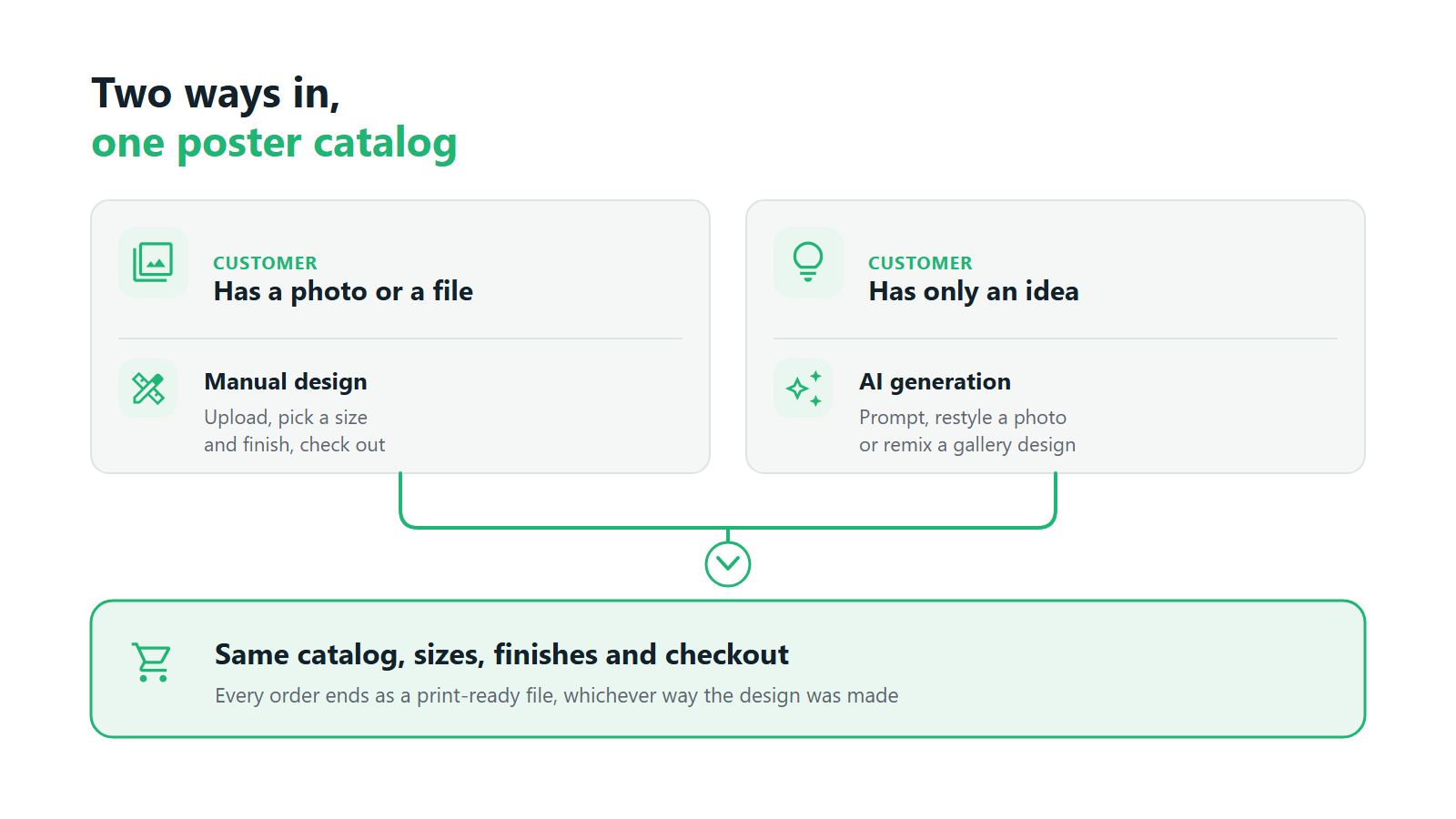
The manual path on Printbox runs on the Flex editor, the same editor the AI path plugs into, where customers personalize the design with a realistic live preview and choose the size and finish, such as matte or glossy. The same platform handles a single custom print and a large order of dozens or hundreds of prints in one session, with quantity-based price tiers you configure. Frame options can be added to the catalog as well; how framed and unframed posters differ as products is covered in our guide to framed vs. unframed print-on-demand posters.
Masterpiece AI is an optional extra entry point. Adding it keeps the manual design path exactly as it is, so the customer with a ready file and the customer with only an idea both find a way to order. For an AI generated poster art business, this matters because the two groups often overlap: the same person may upload a photo for one poster and generate artwork for another in the same visit.
Printbox keeps one poster catalog for both creation paths. You define the poster products (sizes, finishes, variants) once in Printbox, and EC Sync keeps that catalog in sync with your store automatically, in one direction from Printbox to your storefront, with no custom sync code. It works with Shopify, Shopware, or any custom store via API. Both creation paths end in the same place: AI-generated art goes through Printbox’s standard print engine, every order gets a print-ready file automatically, and orders flow to production on their own track. There is no separate AI catalog to maintain. The full setup is on the EC Sync page, and the print-on-demand posters software page shows how the poster offer fits together.
Frequently Asked Questions
Do customers need design skills to create an AI-generated poster?
No. The customer describes the poster in plain words or uploads a photo, and the AI produces the artwork. Shoppers who struggle to phrase a prompt can start from an inspiration gallery and remix a design instead. That low entry point is the main reason stores choose to sell AI generated posters in the first place: it opens the category to the many shoppers who would never open a design tool.
How is AI poster generation different from a template library?
A template library offers a fixed set of designs that every visitor sees, and customers personalize them within the limits the template allows. AI generation creates new artwork for each request, so the catalog effectively grows with every prompt. Undecided shoppers still need a curated starting point, so stores selling print on demand AI art posters pair the prompt box with an inspiration gallery.
Can I control what kind of content the AI generates for my store?
Yes. Masterpiece AI moderates every prompt automatically, blocking hate, violence, sexual content, and self-harm, along with prompts that reference copyrighted characters or styles and public figures.
Can I offer both manual design and AI generation in the same catalog?
Yes. AI is an optional extra entry point, and the manual editor stays in place. Both paths use the same poster catalog, which EC Sync keeps in sync with your Shopify, Shopware, or custom store, so you manage one set of products for both. If you are still comparing platforms, our guide to choosing print-on-demand poster software lists what to check.
What are the key features of Printbox’s AI-assisted poster tool?
As an AI poster generator for print on demand sellers, Masterpiece AI offers text-to-image generation, image-to-image restyling of customer photos, and an inspiration gallery to remix. Every output is upscaled to print resolution and turned into a print-ready production file automatically, and every prompt is moderated. For Shopify merchants, the Masterpiece AI app in the Shopify App Store adds it through app blocks, with no theme rebuild on a new install, which makes it a practical AI poster design tool for stores that already run on Shopify. Printbox itself is white-label: you print on your own presses or through a fulfillment partner, and Printbox has launched stores in more than 50 countries. One catalog for AI and manual design keeps a range of print on demand AI art posters manageable as it grows.

Sylwia Kopeć
She collaborates with her team to develop and implement the company's marketing strategies. With a strong background in marketing communications, online marketing, and content marketing, she efficiently integrates these strategies into the brand. Her focus on omnichannel digital campaigns, keen analysis of client needs, and creative approach have delivered significantly enhanced Printbox's market presence.