Email Marketing for Photo Product Brands: Strategy, Stack and a Pre-Send Audit

Falling open rates and flat conversion are warning signals no photo product brand can afford to sit on. If your entire email programme is a stream of discount codes, there is value dormant in your customer base that you never touch. Email in this industry runs on two things at once: engineering and emotion. Weak on either side, and the channel underperforms.

Strategy First: Define Who You Are Selling To
The first question to answer is who you are and what value you bring to your customers’ lives. Strategy is the way you run the business – a clear view of what you do, an awareness of what you deliberately leave out, a specific reading of customer needs, and a narrative that holds all your activity together.
That starts with defining the customer. In photo products you speak very differently to a professional photographer ordering thousands of prints for clients than to a mother making a keepsake from a family holiday.
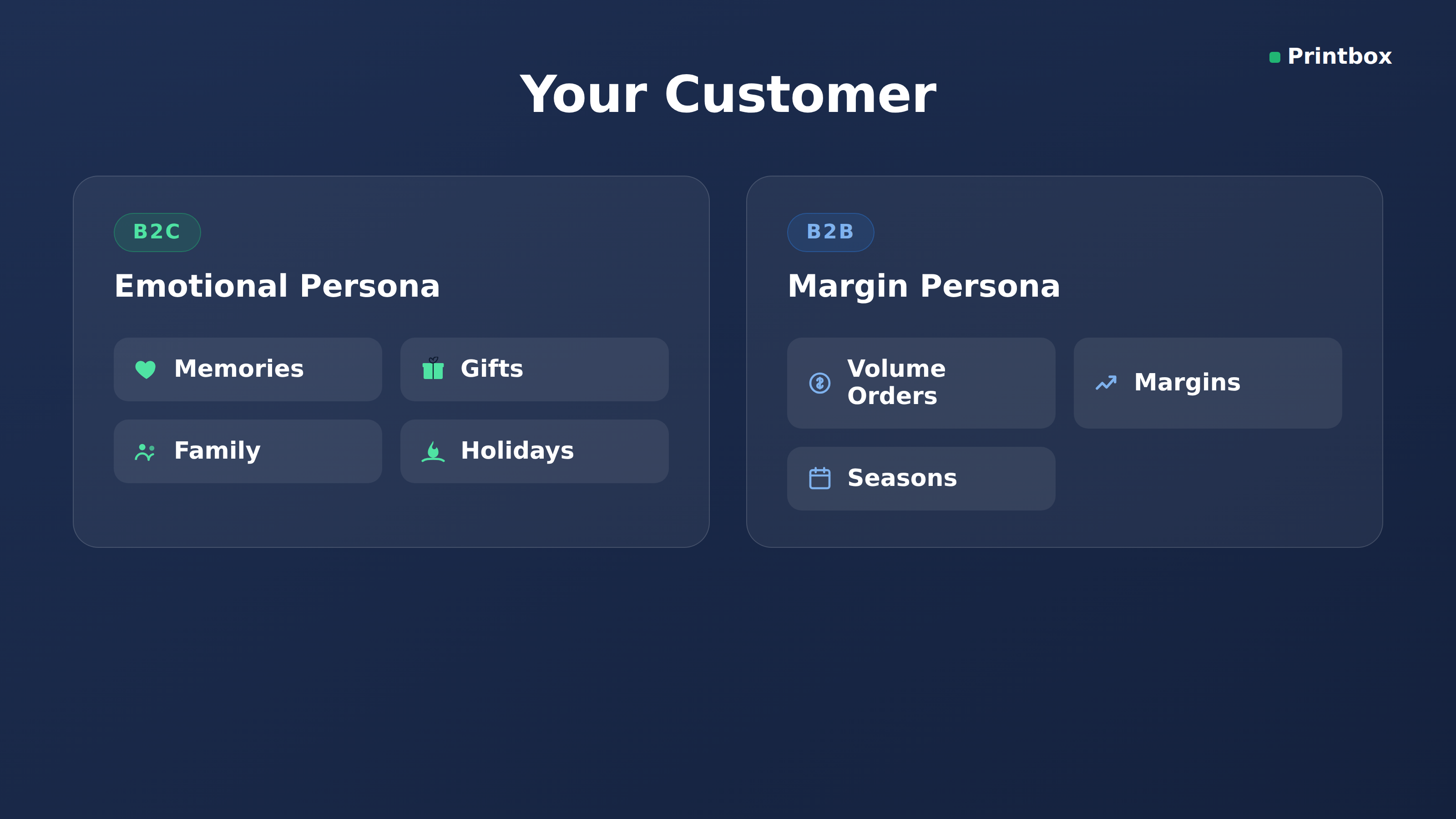
Purchasing motivation splits personas into two types:
- The emotional persona (B2C, individual customer)
- The margin and volume persona (B2B customer)
Language, priorities and business goal all need settling before the first message goes out. You have to know whether an email should be personal and emotional or whether it should demonstrate hard business value. Mix both worlds into one list and you get unsubscribes and messages that vanish into inbox noise.
WARC’s 2025 study with TikTok found that 71% of respondents pay more attention to advertising they find personally relevant, against 58% for advertising they find culturally relevant. Personal outperforms cultural, which is encouraging in a category where the product is the customer’s own photographs. It only holds if your segmentation is clean enough for “personal” to mean something, and the same discipline that shapes a good email applies on site, where personalized buying paths route different customers towards different products.
Speaking to Emotions vs. Speaking to Business
Speaking to emotion
For emotional personas, warm sentimental language focused on benefits does the work: “Give the gift of joy this holiday”, “Show Grandma you remember her”, “Your summer, on your shelf”. The triggers are calendar occasions – Mother’s Day, Christmas, the end of the school holidays. The goal is LTV: moving a customer who once bought prints towards a higher-value photo book.
That compounding effect is measurable. McKinsey’s 2026 Australian Consumer Loyalty research found that top-quartile loyalty programme members recommend the brand 79% more often than bottom-quartile members, and buy more than twice as frequently. In a category built on repeat occasions – every birthday, every holiday, every new baby – a customer you keep engaged is worth several times one you convert once and forget.
Speaking to business
The margin persona wants concrete, benefit-driven language. Reliability and predictable turnaround are what count: “Expand your offer with premium photo books”, “Order over 100 prints and get the next 100 at X% off”. The triggers are industry seasons – weddings, communions, graduations – and reminders to prepare offers for their own clients. Printing technology news and production insight add genuine value here. This is how B2B loyalty gets built: the photographer cares whether your product lets them earn more.
Technology and Integration: The Backbone of Success
An effective strategy needs a technical backbone underneath it. The decisive choice is a dispatch tool that can talk to the editor. The scenario worth aiming for is an abandoned-cart email showing a thumbnail of the customer’s own unfinished project instead of a stock photo. Recovery emails are the highest-leverage flow you own, and they sit alongside the other tactics for reducing cart abandonment on photo products, where an unfinished design is the thing being abandoned.
Printbox ships this as a plugin for Shopware. Every project a customer starts in the editor is saved with its own ID. When a cart goes idle, the plugin sends a reminder after a configurable delay, carrying a rendered thumbnail of that unfinished project and a link that reopens that exact project directly in the editor, so the customer lands back inside their own design. Reminder delays, the number of emails in the sequence and the template content are all configurable in the store admin. This is a Shopware plugin today, so on Shopify or other platforms you would be building the same pattern yourself, which is a question of how your photo editor is integrated over a web-to-print API in the first place.
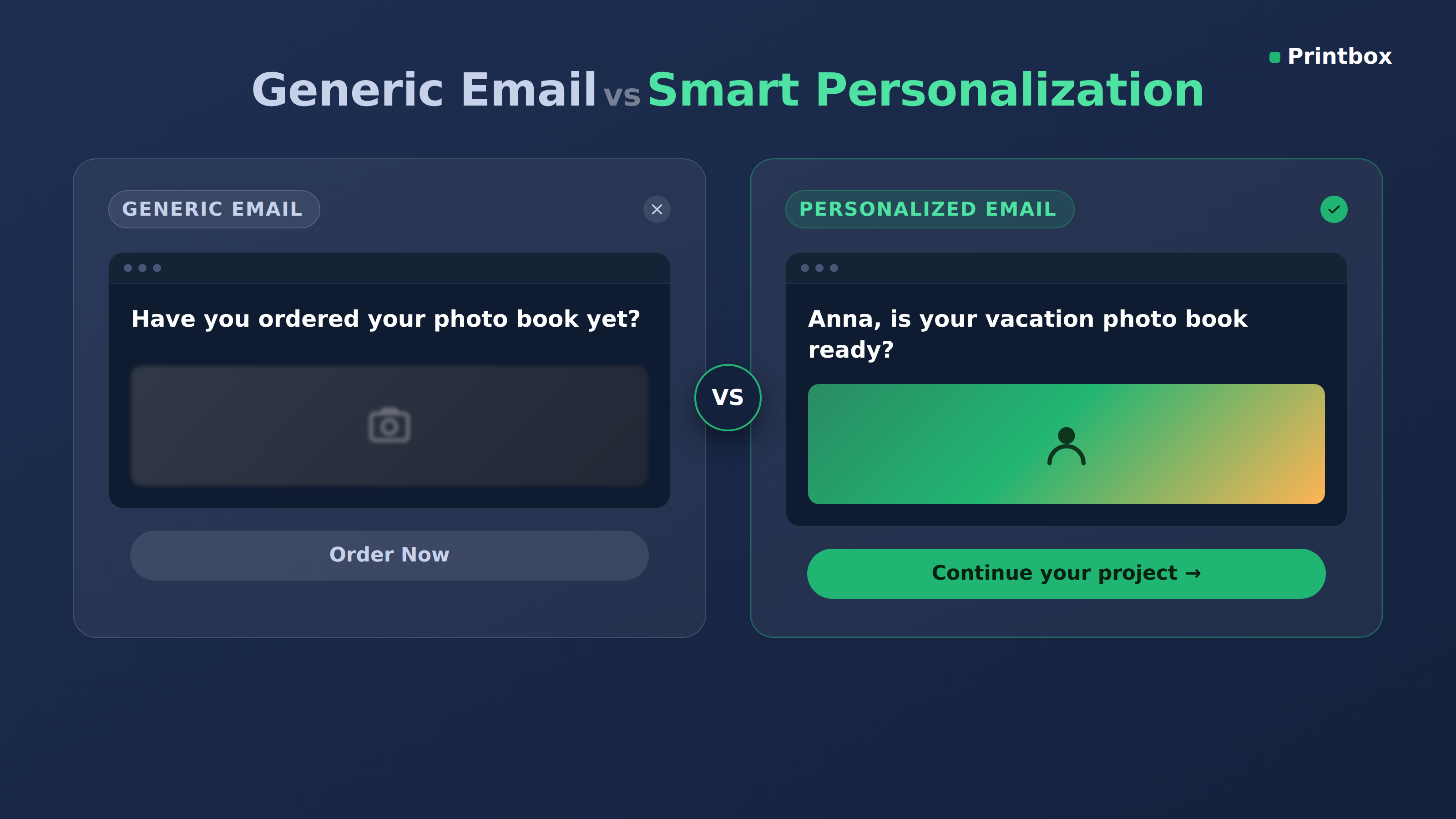
Personalization goes past the greeting. It runs on custom fields populated dynamically through API or plugins. Consider the gap between a subject line reading “Have you ordered your books yet?” and one reading “Anna, is your holiday photo book ready?” Most marketing platforms and Shopify plugins let you inject those data points without heavy engineering, which is what makes an email feel like a one-to-one conversation.
Redfox’s Trends in User Journeys 2025, drawing on Adobe Digital Trends data, found 84% of consumers described a personalized birthday offer as “cool” against 16% who called it “creepy”. Personalization built on data the customer knowingly handed you – their name, their project, their occasion – lands on the right side of that line comfortably.
It is worth auditing what plugins and automations your e-commerce system already offers for editors. Shopify’s ecosystem in particular has free, approachable plugins that let you stand up the essential flows without a large budget, and if you are still weighing that platform, our breakdown of whether Shopify has print-on-demand covers what its POD stack actually gives you. A welcome series and a reactivation campaign for lapsed customers are the baseline of modern e-commerce.
Brand Voice: Consistency is Key
Now to brand voice. Does the language in your emails match the brand? Consistency with your website matters. If you sell colourful, simple photo products with playful layouts, stiff emails will read as though they came from a different company.
Red Antler’s 2025 State of Brand study found half of consumers believe companies often make false or misleading claims about what they offer. Every gap between how your site sounds and how your emails sound feeds that suspicion, and in a category where the customer is trusting you with their own memories, suspicion is expensive.
A common obstacle: how do you stay consistent without a documented brand voice? Focus on how you would speak to this customer face to face, and treat the email as one more surface governed by the same branding fundamentals for a photo products business. Would you tell a couple just back from holiday about paper weight, or about how to keep those memories somewhere they will actually look at them?
💡 Pro Tip:
Build your own AI agent for copy. Teach it your language, feed it examples of your best-performing emails, and correct it as you go. It makes content work faster and keeps communication consistent across every channel. We have written separately about where AI copywriting helps and where it falls short for photo product businesses.
Design: customers buy with their eyes
Next on the map is design. In photo products, customers buy with their eyes. An attractive photo on the PDP is the promise of an attractive print. The same logic governs email: an ugly newsletter suggests low service quality.
DISQO’s Consumer Trends 2025 found previous experience is the single biggest driver of brand perception, named by 60% of consumers, ahead of online reviews (46%) and friends and family (43%). For a subscriber who has never ordered from you, the email in front of them is the previous experience.
YouTube’s Why We Watch 2.0 research across EMEA found 86% of viewers say high-quality content is emotionally resonant, and over 90% say quality has to deliver on both a technical and an emotional level. That is the brief for a photo product email in one line: technically clean, emotionally specific. In this industry the image in the email is the offer, and it does the selling.
AI and mockup generators are genuinely useful for presenting products attractively. Be deliberate about how far you take it: Getty Images research cited in Accenture’s Life Trends 2025 found 90% of people want to know whether an image was AI-generated, and 87% say authenticity matters to them. Generated imagery works well for staging and context. Where you are making an emotional promise about the product itself, real customer projects, used with permission, carry more weight.
💡 Pro Tip:
Check file sizes before dropping images into an email. Quality matters, and so does compression – otherwise the email takes an age to load. Add alt text while you are there. When images fail to load, the customer sees blank space; with alt text they see “A4 Hardcover Photo Book – perfect for holiday photos, -20%”. That often saves the conversion. A customer opening your email on a weak train signal and finding emptiness closes it in a split second.
The Mobile-First Challenge (and How to Solve It)
A mobile-first approach is now table stakes. The recipient decides within a few seconds whether to engage. The email has to be responsive, and nothing can look broken on a phone, which is the same standard you should be holding your e-commerce site itself to, since the email hands off to it. Then the real problem surfaces: most people check email on a phone, while traditional photo books are designed on a desktop. Bridging those two worlds is the whole game.
There are two paths.
1. A clear “Finish on your computer” CTA. The standard approach, and it leaks conversions at precisely the moment of highest intent.
2. Reduce the work the phone has to do. Printbox’s Smart Creation is an AI module inside the Advanced Editor. The customer uploads their photos and it culls the blurry, duplicate and weak shots, groups what remains by date and visual similarity, and lays out the spreads in the store’s chosen theme while avoiding crops through faces. What comes back is a complete, orderable photo book draft in minutes, which the customer can still edit by hand. It runs in the browser on desktop and mobile alike, with no app to download, which is what makes it usable straight from a tap in an email. It covers multi-page photo books and is enabled per product in the store admin.
The technological barrier is the thing standing between a phone tap and a finished project. Removing it is worth more than any subject line test.
Educate to Sell: Emails as Guides
Email campaigns work well as guides. When conversion drops, ask whether you have actually explained to customers what their options are. Content recycling is fundamental here. Reuse material from your landing pages – a comparison of making a photo book with AI against building one manually, for instance. Prepare short visual guides: “How to order a gift mug in three steps”. Those pieces build loyalty because they tell a story instead of shouting “PROMOTION”.
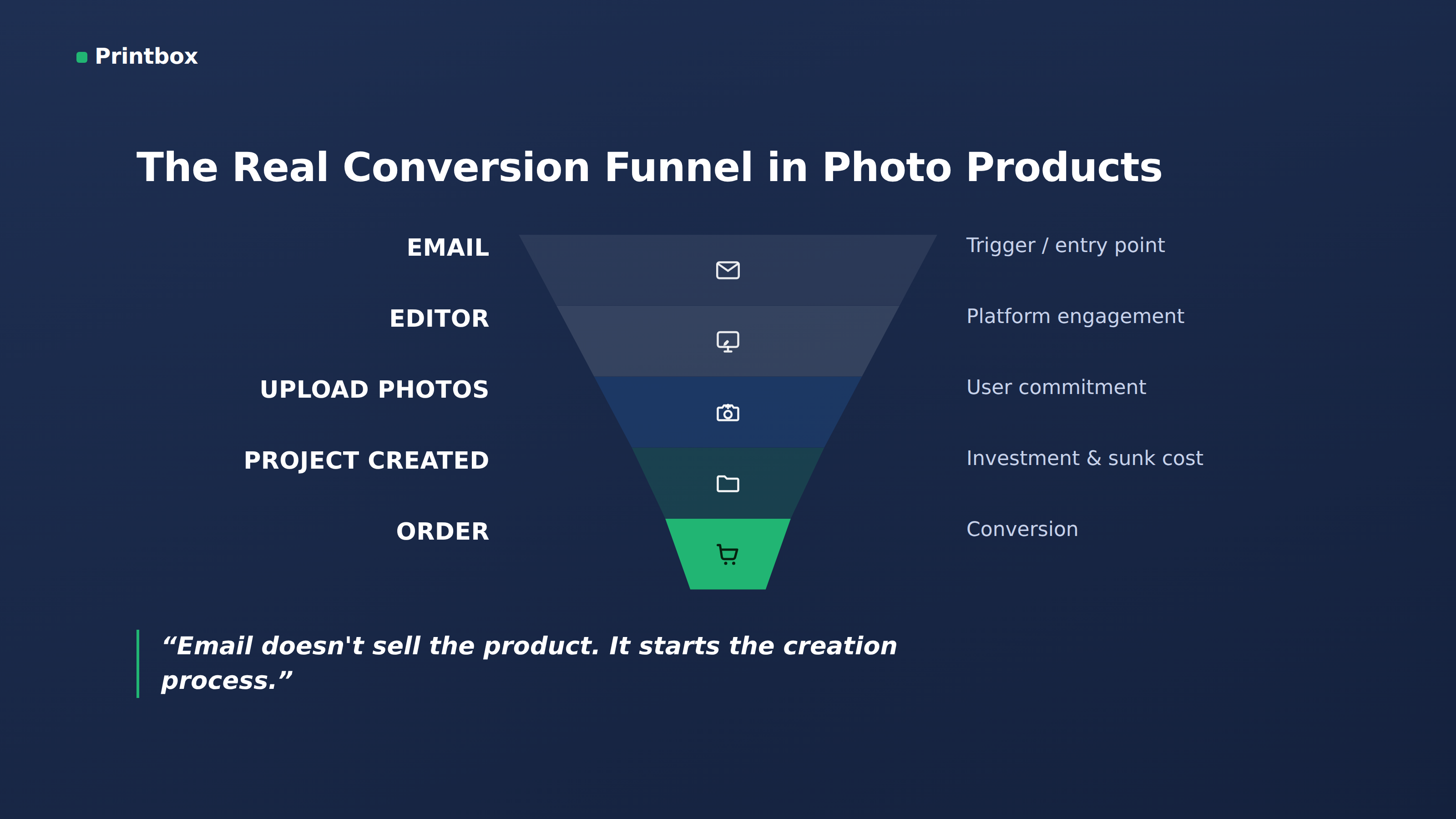
Building a strategy is a process, and so is building customer trust. You need conviction about the vision, backed by solid analysis, personalization and segmentation. Stop looking only at how many people opened the email. In personalized photo products, success is measured by how many people entered the editor and uploaded a first photo because of your message. You are selling a product that has to be created before it can be bought, and your analytics has to account for that. An email is often the spark that starts the fire, even if the marshmallows do not get roasted until a week later.
Pre-Send Audit: 15 Questions to Ask Before You Click “Send”
A good strategy needs precise execution, and the best plan can still fail on technical detail. Before you launch, challenge the campaign with the questions below. Fifteen straight yeses means you are ready.
1. Strategy and segmentation
- Is the goal clearly defined? Decide whether this email is meant to move people emotionally (B2C, emotion) or demonstrate profit potential (B2B, margin).
- Are your segments clean and differentiated? Are you certain a “Gift for Grandma” offer is not going to a professional wedding photographer? And are active VIPs separated from dormant users, with offers tailored accordingly – appreciation versus reactivation?
- Is there a strategic trigger? Does the send have a specific reason: a season, on-site behaviour such as an abandoned cart, or a planned reactivation? Avoid sending “just because”.
2. Technology and integration
- Did you test the cart integration? Walk the path as a customer. Abandon a project, then check that the link in the email leads back into that specific project in the editor. This is what closes the sale.
- Are your links tracking properly? Make sure they lead to the editor or a dedicated landing page, never the homepage, and always carry UTM parameters so you can measure the result in Google Analytics.
3. Design and UX, mobile first
- Does it pass the thumb test? Open it on a phone. Is the CTA button easy to hit with a thumb, without zooming?
- Are the images optimized? Have you compressed the graphics so the email loads instantly, even on a weak connection?
- Did you include alt text? Does every image carry an alternative description, such as “Photo Book A4, 20% off”, in case images fail to load?
4. Content and brand voice
- Does it sound human? Read it aloud. Do you sound like someone talking to a client in a studio, or like a robot generating announcements?
- Is there value beyond the sale? Does the email offer more than “BUY”? Advice, inspiration, a story.
- Do the subject line and pre-header work as a pair? Check how both render in the inbox preview, on mobile and desktop. The pre-header is a second headline, and a default fallback wastes it.
5. Analytics, post-send
- Are you measuring the right metrics? Look past open rate. Check whether the campaign translates into store visits (CTR) and finished orders.
- Did you check the attribution window? In photo products the decision takes time. Analyse sales up to 30 days after the send.
6. Hygiene and safety
- Is the unsubscribe link visible? Do not make leaving difficult. Hiding the link leads straight to the spam folder and damages your domain reputation.
- Is your list legal? Do you have marketing consent from every recipient? A small consented list outperforms a large scraped one, and consent is one piece of the wider question of whether your photo product e-commerce is GDPR compliant.