How to Increase Sales of Personalized Products: Year-Round Conversion Strategies

Holiday peaks come and go, but the barriers that stop shoppers from buying stay in place all year. This guide focuses on the underlying problems behind low conversion and low order value in personalized product stores: shoppers who never start designing, a creation process that feels like work, carts with a single item, and customers who buy once and disappear. Each of these can be improved in any month, and fixing them raises the baseline that every seasonal campaign builds on. For growing catalog, production, and channels, see our guide Is Print-on-Demand Scalable?
Why Most Visitors Never Convert
Advice on how to increase sales of personalized products often starts at the checkout. In this category, the data points to an earlier step.
According to Printbox’s Crisis and Risk Mitigation in the Personalized Products Market 2026 report, in many cases approximately 88% of visitors to personalized product stores never even enter the product editor. They land on a product page, look at what creating the product will involve, and leave before uploading a single photo. That makes the step into the editor the largest conversion barrier in personalized commerce. The effort that designing seems to take stops buyers before they begin. We break down the full funnel in our analysis of why visitors leave photo product stores without buying.
The practical implication is simple. Before you spend more on traffic, look at the share of visitors who start a project. Clear “start designing” calls to action, ready-made templates on the product page, and a first step that asks for as little as possible all help more shoppers cross that line. That first step is where you boost conversion for custom products without buying more traffic.

Reduce Friction in the Design Experience
Once a shopper is in the editor, every extra decision and every moment of uncertainty is a chance to abandon. Start with two things.
Real-time preview. Shoppers need to see what they will receive: the cover with their photo, the page layout, the canvas on a wall. A live preview that updates as they design addresses a common doubt behind personalized purchases, which is whether the result will look good.
Mobile-first design. Many of the photos people want to print live on their phones, so the editor has to work there too. An editor that works properly on a small screen, with simple gestures and photo upload straight from the gallery, is the baseline today. Our guide to mobile conversion strategies for personalized print covers this in detail.
Automation removes even more of these obstacles. Printbox’s Smart Creation lets customers build a complete photo book in a few clicks by pulling images from their phone or social feeds and arranging them automatically. According to Printbox’s review of profitable photo products for 2026, clients report up to a 40% shorter time-to-checkout for youth-oriented photo book products. A shorter path from first photo to finished design leaves fewer moments to give up, which is how automation helps boost conversion for custom products.
Increase Average Order Value with Bundling and Sets
Conversion is only half of the revenue equation. The other half is how much each customer spends, and personalized products are well suited to raising it without discounts.
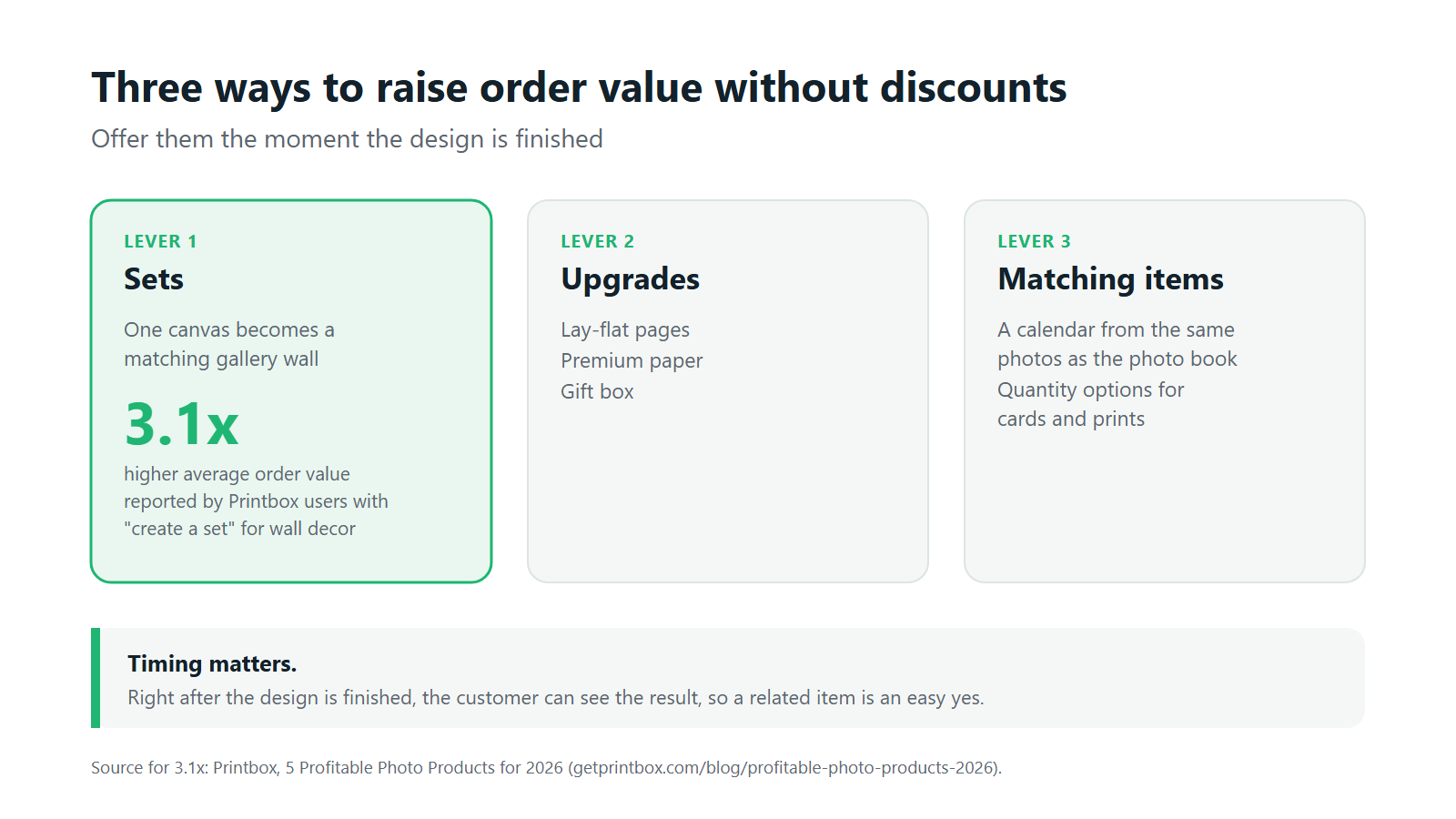
For wall decor, the most promising option is the set. A customer who has just designed one canvas already has the photos, the style, and the emotional investment to create a matching gallery wall. Offering sets as a guided experience inside the editor turns a single purchase into a collection. Printbox users whose wall decor tools include a built-in “create a set” functionality report a 3.1x increase in average order value, as described in the same 2026 photo products review. That result puts sets high on the list of personalized product sales strategies worth testing.
Sets are one option among several. When you want to increase average order value personalized products also reward premium upgrades such as lay-flat pages, better paper, or a gift box; matching items that reuse the same design, like a calendar from the same photos as the photo book; and quantity options for cards and prints. A natural moment to upsell personalized products is right after the design is finished, when the customer can see the result and adding a related item can take a single click. Our guide to upselling photo products has more examples.
Turn One-Time Buyers Into Repeat Customers
Personalized products have a built-in reason to come back: the next birthday, anniversary, holiday, or school year. Saved projects, reminders tied to the occasion a customer bought for, and easy reorders of a previous design turn a one-time purchase into a relationship. We cover this in depth in our article on personalization as a key to customer retention.
Retention also multiplies the effect of everything above. A returning customer already knows the editor, trusts the print quality, and is more likely to buy a set or an upgrade. Among personalized product sales strategies, retention is the one that keeps paying after the first order, because a returning customer needs no new acquisition spend.
Frequently Asked Questions
Does personalization actually increase conversion rates?
It can, but only when the personalization itself is easy. StackAdapt's Retail 2026 report cites McKinsey data showing that 71% of consumers now expect personalized interactions. For personalized products, conversion depends on how easy the personalization is: a simple, guided design experience converts well, while a complicated one loses buyers before they finish. That is why personalization conversion rate optimization focuses on the editor as much as on the product page.
What’s the biggest barrier to converting personalized-product shoppers?
Getting them to start. Printbox's Crisis 2026 report found that approximately 88% of visitors never enter the product editor. Templates, a clear first step, and fast photo upload help more shoppers begin a project. Once they start, a live preview and a mobile-friendly editor help them finish. That is how stores reduce cart abandonment personalized products are prone to, starting well before the cart.
How can I increase average order value without discounting?
If you want to increase average order value personalized products give you three levers that need no discount: sets, upgrades, and matching items offered the moment the design is finished. Sets are especially effective for wall decor, where Printbox users whose tools include a "create a set" functionality report a 3.1x increase in average order value. Premium materials, gift packaging, and products that reuse the same photos add value without cutting your price.
Are these tactics different from seasonal or holiday sales strategies?
They work alongside them. Seasonal campaigns bring traffic at specific moments, while the tactics in this guide improve how well your store converts that traffic all year. A store with a better editor entry rate, a shorter design process, and higher order value gets more out of each holiday campaign, so the question of how to increase sales of personalized products starts with these year-round fixes.
What are the key features of Printbox’s software for improving conversion?
Printbox offers several editors for different products and business needs, including the mobile-first Flex Editor, which lets customers create and edit designs on any device. Smart Creation builds complete photo books automatically from a customer's photos, and clients report up to 40% shorter time-to-checkout for youth-oriented photo book products. For wall decor, Printbox users whose tools include a built-in "create a set" functionality report a 3.1x increase in average order value. Together, these tools cover both halves of how to increase sales of personalized products: more shoppers finish a design, and each order is worth more. If you are comparing the best web-to-print software for your store, editor entry and time-to-checkout are the numbers worth asking every vendor about.

Sylwia Kopeć
She collaborates with her team to develop and implement the company's marketing strategies. With a strong background in marketing communications, online marketing, and content marketing, she efficiently integrates these strategies into the brand. Her focus on omnichannel digital campaigns, keen analysis of client needs, and creative approach have delivered significantly enhanced Printbox's market presence.


