You’re overseeing significant changes in your corporate print strategy, and you’re facing a familiar dilemma. On one side: the high costs and limits of existing legacy systems. On the other: the risks and rewards of a modern B2B web to print platform. It’s a strategic decision that could reshape how your organization manages web to print procurement. This isn’t just an operational tweak; it’s a chance to shift print from a mere expense into a driver for growth and efficiency. At this crossroad, you’re likely wondering if the switch is worth the investment. You also want to know how it will affect scalability and compliance in your print operations.
By digging into the details of B2B web to print solutions, you’ll get a framework for aligning your digital strategy with your business goals. This is not about features alone; it’s about using architecture and process automation in ways that directly support your corporate agenda. By the end, you’ll gain clarity on optimizing ROI, mitigating risks, and seizing competitive advantages. You’ll be positioning your print portal as a strategic asset, not just an operational necessity.
What Is B2B Web-to-Print?
B2B web to print software is designed to simplify the corporate print procurement process. In short, this is web to print for business, built for procurement, approvals and scale rather than one-off consumer orders. Traditional print ordering is slow and prone to errors. B2B web to print integrates directly into your business operations, so you get efficiency, cost control, compliance, and scalability. For large corporations, moving to a corporate web to print store isn’t just about convenience. It’s a strategic necessity, and it’s how you keep competitive advantage and control over procurement. In practice the payoff is financial: McKinsey’s State of the Consumer 2025 links sustained technology and AI investment to as much as a 15-percentage-point improvement in EBITDA margins, which is why web to print procurement is now a board-level priority, not a back-office one.
The most sophisticated corporate print operations have quietly shifted their web-to-print investment from cost-reduction tools to enterprise control infrastructure – using the platform to govern brand consistency, procurement compliance, and supplier relationships at scale. Organizations that treat their print portal as a digital order form, rather than a configurable business system, tend to absorb compounding costs: brand dilution, approval bottlenecks, and procurement that fragments as headcount grows. Architectures designed for this complexity embed governance logic – approval chains, user hierarchies, and brand constraints – directly into the ordering environment, not as add-on features bolted onto a consumer-grade foundation.
As demands for efficiency and sophisticated control grow, B2B web to print software is becoming the norm. For C-level executives, understanding its strategic role is crucial in defining the company’s success in print procurement and broader operational contexts.
Key Differences Between B2B and B2C Web-to-Print
Understanding the fundamental differences between B2B and B2C web-to-print solutions is key to optimizing your enterprise’s print portal. B2B web to print platforms are tailored for complex organizational needs, involving intricate order complexity, detailed approval workflows, and comprehensive user management. In contrast, B2C solutions often focus on a simplified, consumer-centric experience, which might not meet the multifaceted requirements of large enterprises. B2C tools optimize for a single shopper; web to print for business optimizes for the whole organization behind the order.
In the context of an enterprise, a corporate web to print store demands capabilities that extend beyond consumer-grade solutions. These include ensuring compliance, enabling bulk ordering, and facilitating integration with existing corporate systems. When setting up a B2B web to print storefront, choose a solution that aligns with these needs. It should offer a dependable infrastructure that supports compliance and operational efficiency.
Understanding B2B Web-to-Print Workflow is essential for grasping how these differences resonate in practical terms, impacting everything from day-to-day operations to long-term strategic alignment.
Must-Have Features of a B2B Web-to-Print Platform
For a B2B web to print platform to truly succeed and improve your corporate operations, it must incorporate several essential features. Each of these features not only addresses a specific pain point but also provides strategic business value.
Approval workflows are critical for ensuring compliance and accountability in corporate orders. This feature simplifies the process, reduces manual oversight, and guarantees that every order meets corporate standards.
User roles & permissions accommodate complex organizational hierarchies, allowing for customized access and controls tailored to each user’s role within the enterprise. This flexibility is essential for maintaining security and operational efficiency.
Volume pricing & discounts are crucial for procurement cost optimization. By integrating this feature, enterprises can negotiate better deals and tighten procurement budgeting, enhancing financial predictability.
Branded corporate portals maintain brand consistency at scale. By controlling the visual and functional aspects of the print portal, organizations reinforce their brand identity while meeting operational needs. Branded templates aren’t cosmetic. 96% of marketers report increased sales from personalized experiences (HubSpot, State of Marketing 2025). A consistent b2b web to print storefront keeps every location on-brand while it sells.
Maximizing Sales with Personalized Products can also be integrated into these platforms, enabling their use during peak sales seasons and aligning with corporate growth strategies.
PO & invoice management connects cleanly with corporate finance workflows. Simpler financial operations lead to better oversight and transparency, critical for fiscal accountability.
Reorder & order history: B2B buyers repeat the same orders constantly. One-click reordering and a full order history cut admin work and turn routine print into predictable, repeat revenue.
Template & brand-asset library: Pre-approved templates with locked and editable zones let local teams personalize materials within brand guardrails, so nothing goes to print off-brand.
Integrations & reporting: SSO, plus ERP and MIS connections through an open API, tie the portal into your existing stack and procurement systems. Built-in reporting then shows spend by department, cost center and reorder frequency, which keeps budget reconciliation clean. Our guide to the best web-to-print software compares how leading platforms handle B2B portals.
In enterprise web-to-print procurement, the critical gap is rarely a missing feature – it’s the absence of integration between features that should function as a unified system: approval chains disconnected from finance workflows, pricing engines blind to contract terms, branded portals that break down at checkout. For decision-makers building the ROI case, this architectural fragmentation is where projected savings go; each disconnected module creates its own reconciliation burden, eroding the efficiency gains the platform was procured to deliver. The infrastructure that closes this gap treats approval logic, volume pricing, user governance, and brand enforcement not as separate modules, but as native dimensions of the same procurement environment.
How to Build and Launch a B2B Web-to-Print Store
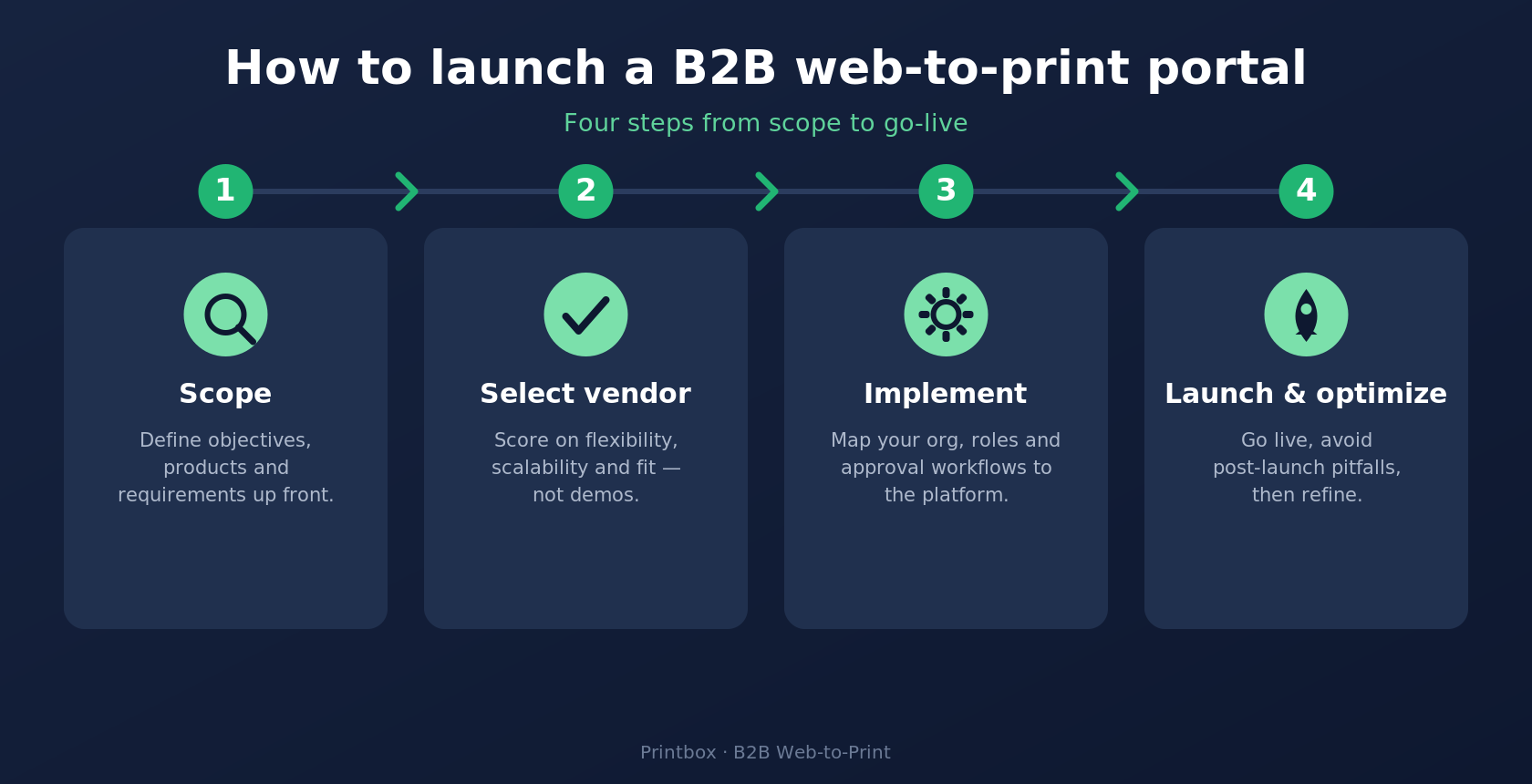
Launching a successful B2B web to print storefront requires a strategic, step-by-step approach. The process starts with comprehensive scoping to define project objectives and requirements clearly. Selecting the right vendor becomes the next critical step, where criteria should focus on flexibility, scalability, and alignment with your specific business needs.
Implementation should commence with a strong foundation in organizational and process mapping, ensuring that the platform is tailored to your operational reality. This preventative approach mitigates common pitfalls and aligns the platform with existing workflows, minimizing the need for costly adjustments post-launch.
The most common failure mode in enterprise web-to-print rollouts is not technical but methodological: platforms selected on feature demonstration rather than configurability tend to reveal their constraints only after go-live, when the gap between the vendor’s reference model and the organization’s actual workflows becomes the implementation team’s permanent problem. For C-level leaders, the real TCO calculation includes not just licensing and integration costs, but the organizational cost of working around a system that wasn’t designed to flex – a burden that compounds with every new market, product line, or acquisition. Implementation methodologies that begin with organizational and process mapping, before a single workflow is configured, produce fundamentally more durable deployments – because the system’s logic is built around the client’s operational reality from day one.
Change management and stakeholder alignment are equally important, requiring clear communication and objectives to ensure buy-in and smooth adoption. As the project unfolds, ensure you measure success through clearly defined KPIs, including ROI and adoption rates.
Starting an Online Store offers additional insights into the nuances of launching your enterprise web-to-print storefront effectively, ensuring it meets strategic and operational goals.
Taking the Next Step
By now you should have a clearer picture of what a B2B web to print platform can do. Used well, it reshapes your corporate print operations into a cohesive, efficient engine of growth. Future-proofing matters too: agentic commerce, where AI assistants buy on the organization’s behalf, is projected to reach $900 billion to $1 trillion in U.S. B2C sales and $3 to $5 trillion globally by 2030 (McKinsey, 2025), so a b2b web to print solution should expose clean, structured product data today. If you’re ready to explore how this solution can work for your company, Book a Printbox demo to see the platform’s capabilities in action. For tailored advice and guidance, feel free to contact the Printbox team – they’re here to help you in defining the next steps for your print strategy overhaul.

Sylwia Kopeć
She collaborates with her team to develop and implement the company's marketing strategies. With a strong background in marketing communications, online marketing, and content marketing, she efficiently integrates these strategies into the brand. Her focus on omnichannel digital campaigns, keen analysis of client needs, and creative approach have delivered significantly enhanced Printbox's market presence.