Thinking About Building Your Own Personalization Platform? Read This First.

Your dev team can probably build it. That’s not the question worth asking.
The better question is what building actually costs, because most teams go into this decision with only the first number, not all of them.
If this decision is on your table in the next few months, this article is worth 6 minutes of your time.
An Old Debate, New Conditions
For years, “build vs. buy” felt straightforward: build if you want control, buy if you want speed. In a world of monolithic platforms and migrations that could sink a quarter, that framing made sense. It doesn’t anymore.
“Buying” no longer means accepting a rigid system you can’t meaningfully touch. “Building” no longer gives you full control, because you’re still dependent on cloud providers, open-source libraries, and AI-generated code that maybe two of your three engineers fully understand, and one of them wrote last Tuesday.
The real question has shifted: what exactly are you building, and why is your team the right team to build and maintain it for the next five years?
In print personalization, that question has sharper edges than in most other software categories. The domain has technical complexity that isn’t visible from the outside: rendering pipelines, CMYK color management, variant handling and production-quality output constraints. The gap between “an editor that looks good in a browser” and “an editor that produces files a print supplier will accept without rework” is years of domain knowledge wide.
What Does Building Really Cost?
When your team scopes a project, the initial estimate almost always covers the same things: a personalization editor, a preview layer, a checkout integration. In 2026, AI tooling means those estimates come together faster than ever, a working prototype can emerge in days rather than weeks.
That speed is real. What it doesn’t change is what happens after you ship. The total cost of ownership of a personalization platform isn’t defined solely by its surface features, but by the infrastructure underneath, the parts nobody puts on a sprint board until something breaks in production. Annual software maintenance typically runs 15–25% of the original build cost, every year the software is in active use (it reflects a practical budgeting benchmark (’thumbnail rule’) that emerged from software valuation models and enterprise software support pricing). Most initial estimates capture only the first line item. The rest materializes after go-live, steadily, and without a clear end date.
The full cost picture looks something like this:

The hardest part isn’t building V1, but maintaining V1 while building V2, V3, and V4, as your e-commerce platform, devices, and customer expectations keep changing.
The Editor That “Looks Good” vs. the Editor That Works
Building a personalization editor that works for real users is deceptively hard. Your end customers need to achieve professional-looking results without any design expertise, which means the interface has to carry an enormous cognitive load invisibly.
Consider one narrow example: when a user uploads a custom font, your editor needs to embed it correctly in the PDF output, handle subsetting for file size, verify licensing compliance, and render it identically across devices and operating systems, before a single pixel reaches the supplier. That’s one font. A production editor handles dozens of product types, each with its own constraint set and its own catalog of edge cases you only discover when a real customer hits them.
A company with print expertise, running their own editor in production, recently described their own UI as atrocious, not because they lack skill, but because good personalization UX is simply that hard to get right while simultaneously managing production-quality output. Their users tolerate the interface because there’s no better option for their specific product type. The moment that gap closes on the platform side, the case for maintaining a parallel in-house tool disappears.
AI Makes Building Faster. It Does the Same for Us.
Let’s be direct: AI coding tools noticeably accelerate development. In 2026, that’s more true than it was two years ago: agentic assistants can scaffold entire modules, write integration tests, and debug rendering edge cases at a pace that would have seemed implausible in 2022.
What consistently goes unexamined is the other side of that equation.
The same tools are running inside every mature SaaS vendor’s engineering organization. The velocity multiplier is symmetric. It doesn’t belong exclusively to the build side.
What AI doesn’t accelerate equally is everything that happens before and after the code is written. Architecture decisions, user research, quality assurance, integration work. And above all: the knowledge of what goes wrong in production at scale, knowledge that comes only from experience, not from prompting.
A platform vendor applies AI on top of years of battle-tested infrastructure, domain knowledge accumulated from real production failures, and an architecture already shaped by edge cases your team hasn’t encountered yet. Your team applies the same tools starting from zero.
The teams that moved fastest with AI tooling in 2026 are now maintaining codebases that grew faster than their understanding of them. That’s not a critique of AI; it’s a description of what acceleration without foundation produces.
The Vendor Lock-In Myth
The fear of vendor lock-in earned its credibility honestly. Between roughly 2000 and 2015, it was a completely rational concern: platforms were hardcoded, data lived in proprietary formats, migration meant months of archaeology through systems that weren’t built to be exited.
What’s changed is the architecture, and the market expectations that come with it.
In 2026, any serious platform should offer: API-first access with full feature parity, data export on demand in standard formats, and contractual data portability and exit clauses. These aren’t differentiators, but the entry requirements. A vendor who can’t confirm all three isn’t an industry norm you’re stuck with; it’s a red flag about their architecture or their intentions.
There’s also an inversion that rarely gets named explicitly: building your own solution creates its own form of lock-in, one that’s arguably harder to exit than a vendor contract. You become locked into your own architectural decisions, into the engineers who hold critical context, and into the technical debt that accumulates with every sprint. Exiting a system you built also has a price, one that rarely appears in the original estimate.
📄 Want the deeper analysis?
This is the short version. If you want the full picture (real client case studies, the multi-domain expertise breakdown, the “unknown-unknowns” problem in production, and a closer look at the economics behind each scenario), read the extended report: [click!]
When Building Is the Right Call
Any article that doesn’t openly admit when building is the right answer is just sales material. Let’s say it clearly: there are scenarios where build wins. They’re just narrower than most teams assume going in.
- Personalization is your core product, not a feature. If your company’s entire value proposition is a unique, proprietary personalization experience (if that’s what you’re selling, not a tool you use to sell something else), building makes strategic sense.
- Your team has proven, specific domain expertise in print. Not general software engineering capability: specifically: rendering pipelines, prepress workflows, color management at production scale. This combination exists, but it’s rare. Its absence is the root cause behind most failed build projects in this space.
- Scale and volume can invert the unit economics. There is a point where the long-term cost of maintaining a proprietary system becomes more favorable than a platform license, but that threshold is significantly higher than most teams estimate going in.
- Regulatory or IP requirements that no vendor can legally fulfill. Data residency constraints, classified systems, proprietary algorithms that can’t be exposed to third-party infrastructure. If you’re in one of these environments, building isn’t a preference. It’s a structural requirement.
Already Have Traffic? Validate Before You Commit.
For businesses that already have an audience and are considering expanding into personalized products, there’s a more efficient path than building from scratch: validate before you commit the full budget.
A ready-made platform can be integrated and generate revenue in weeks rather than months. The sooner your customers interact with the product category, the sooner you gather concrete signals about what they want, and you make the build-vs-buy decision with data rather than projections.
Even if you ultimately decide to build your own solution later, you’ll do so with validated demand, direct user feedback, and a much clearer picture of what your platform needs to do.
The question isn’t build or buy forever. It’s: what’s the fastest path to learning what your customers need, and deciding accordingly?
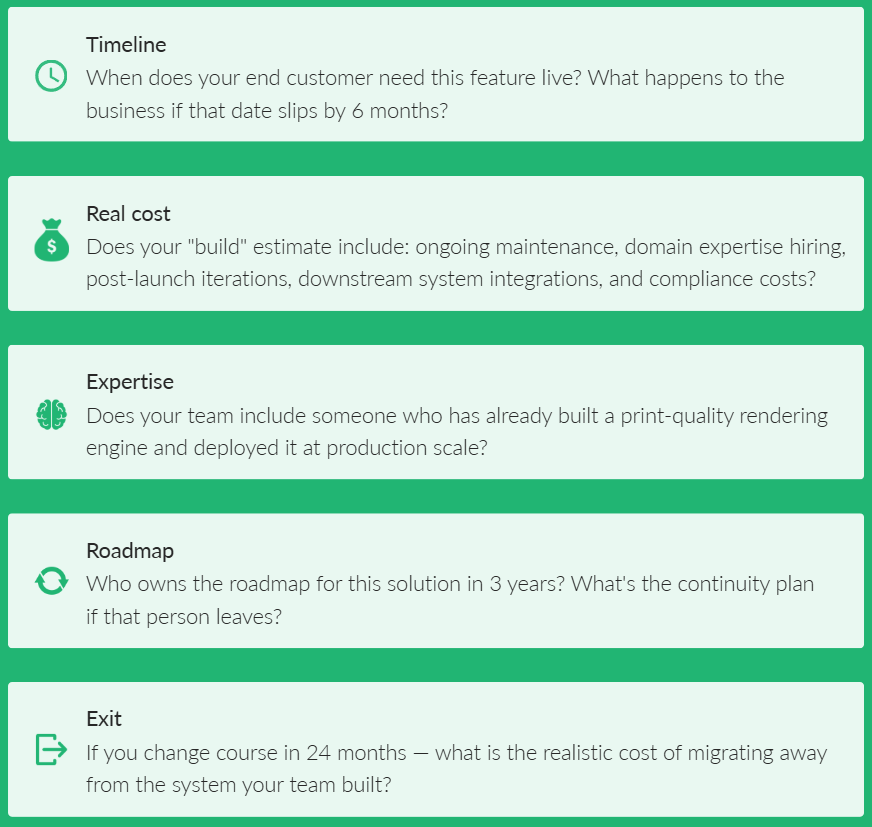
5 Questions Before You Decide
If you can’t answer at least three of these with confidence, it’s worth talking to someone who has seen both scenarios from the inside, before the budget starts to flow.
There’s no universal right answer, only the right answer for your company, your product, your team’s actual capabilities, and where you are right now in your trajectory.
This decision will shape your engineering roadmap, your hiring, and your ability to move at the pace your customers expect, for years after you make it. If you decide to buy, our comparison of the best web-to-print software is a good place to build a shortlist.

Inga Leder-Majewska
Content & Communication Manager in Printbox. She has over 8 years of experience in expert content creation, communication in social media, and PR. In her spare time, she listens to true crime podcasts and plays with her toddler.